Piperazine → HCID 11201996, compound
Reaction equation
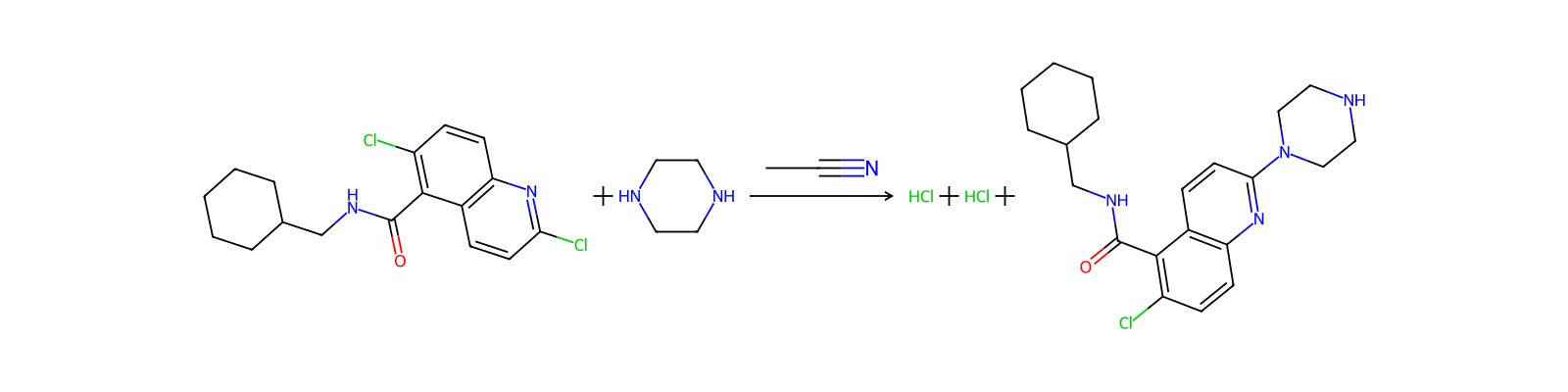
[Cl:1][C:2]1[CH:11]=[CH:10][C:9]2[C:8]([C:12]([NH:14][CH2:15][CH:16]3[CH2:21][CH2:20][CH2:19][CH2:18][CH2:17]3)=[O:13])=[C:7]([Cl:22])[CH:6]=[CH:5][C:4]=2[N:3]=1.[NH:23]1[CH2:28][CH2:27][NH:26][CH2:25][CH2:24]1>C(#N)C>[ClH:1].[ClH:1].[Cl:22][C:7]1[CH:6]=[CH:5][C:4]2[N:3]=[C:2]([N:23]3[CH2:28][CH2:27][NH:26][CH2:25][CH2:24]3)[CH:11]=[CH:10][C:9]=2[C:8]=1[C:12]([NH:14][CH2:15][CH:16]1[CH2:21][CH2:20][CH2:19][CH2:18][CH2:17]1)=[O:13]Participants
4
Reactant 2


Product 1

Reagents, catalysts & solvents 1

Procedure
A stirred solution of 2,6-dichloro-N-(cyclohexylmethyl)quinoline-5-carboxamide (Example 43 (a)) (200 mg) and piperazine (160 mg) in acetonitrile (2 mL) was heated at 80° C. in a CEM Discover microwave for 1 hour after which it was cooled to room temperature and concentrated. The residue was purified (Waters' SCX resin, ammonia in methanol (7 M) as eluant) and the resultant product was converted to the dihydrochloride salt by treatment with hydrochloric acid (4M in 1,4-dioxane). Recrystallisation (methanol/ethyl acetate) afforded the title compound as a solid (110 mg).
Workup
- customwas heated at 80° C. in a CEM Discover microwave for 1 hour
- concentrationconcentrated
- customThe residue was purified (Waters' SCX resin, ammonia in methanol (7 M) as eluant)
- customRecrystallisation (methanol/ethyl acetate)
Sources & evidence
- ORD record
- ord-8fe27363cd784db28322b139749aeb9b
- Source dataset
- uspto-grants-2008_08
- Patent number
- US07408065B2
Reaction notes
Loading…