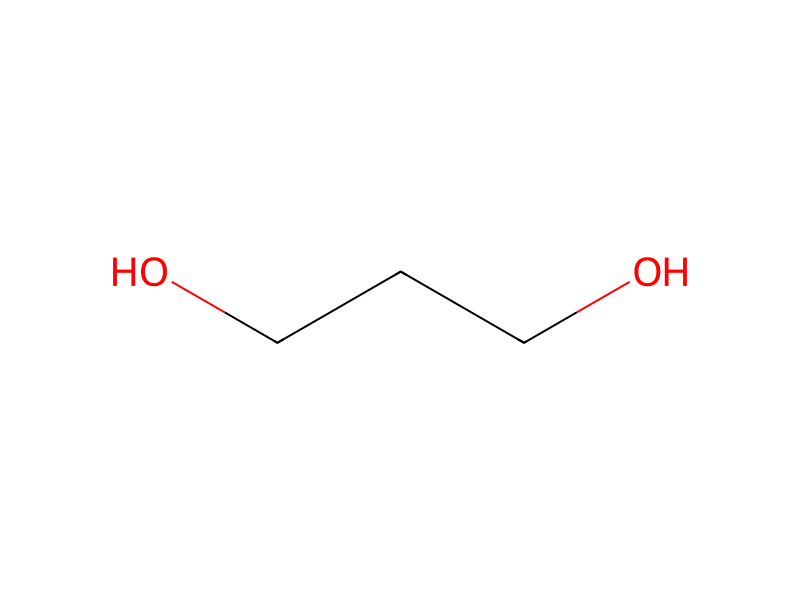
1,3-Propanediol → HCID 131716352, compound
Reaction equation

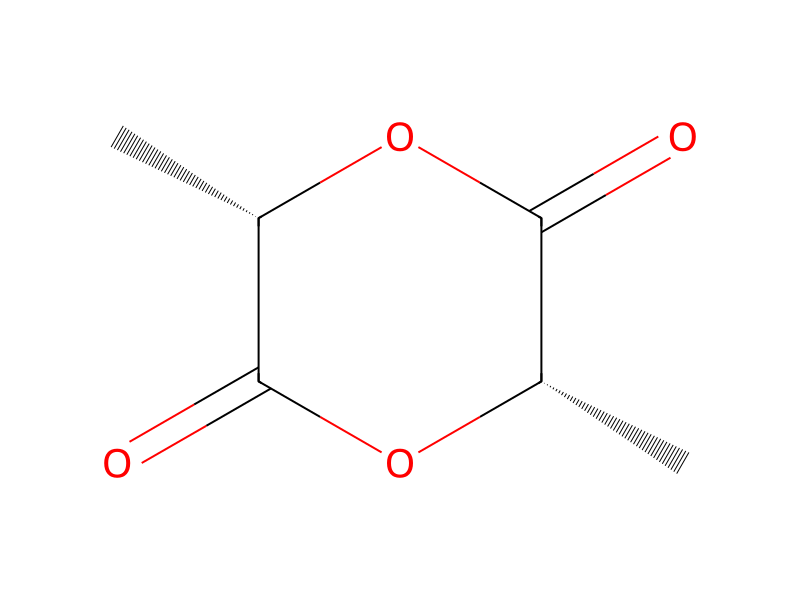
[CH3:1][C@@H:2]1[O:9][C:7](=[O:8])[C@H:6]([CH3:10])[O:5][C:3]1=[O:4].[C:11]1(=[O:17])[O:16][CH2:15][CH2:14][CH2:13][O:12]1.C(O)CCO>>[CH3:1][C@@H:2]1[O:9][C:7](=[O:8])[C@H:6]([CH3:10])[O:5][C:3]1=[O:4].[C:11]1(=[O:17])[O:16][CH2:15][CH2:14][CH2:13][O:12]1Participants
4


Procedure
The copolymer (Co—P4) was prepared following the teaching of U.S. Pat. No. 6,342,065 by the two-step copolymerization of l-lactide with trimethylene carbonate in the presence of 1,3-propanediol and stannous octanoate as the initiator and catalyst, respectively. The polymer was isolated, ground, dried, and heated above 80° C. under reduced pressure to remove residual monomer. The polymer was characterized for identity (IR), thermal properties (DSC), and molecular weight by GPC (CH2Cl2). The polymer was shown to have a Tm=166° C. and Mw=160 kDa. The copolymer was then compression molded into a 0.1 mm-thick film at 180° C.
Workup
- customThe copolymer (Co—P4) was prepared
- customThe polymer was isolated
- customground, dried
- temperatureheated above 80° C. under reduced pressure
- customto remove residual monomer
- customa Tm=166° C. and Mw=160 kDa
- customat 180° C.
Sources & evidence
- ORD record
- ord-cea2d554213747e394eabace109cee7c
- Source dataset
- uspto-grants-2008_08
- Patent number
- US07416559B2
Reaction notes
Loading…