Hydrochloric Acid → 4-(cis-4-Hydroxycyclohexyl)phenol
Reaction equation
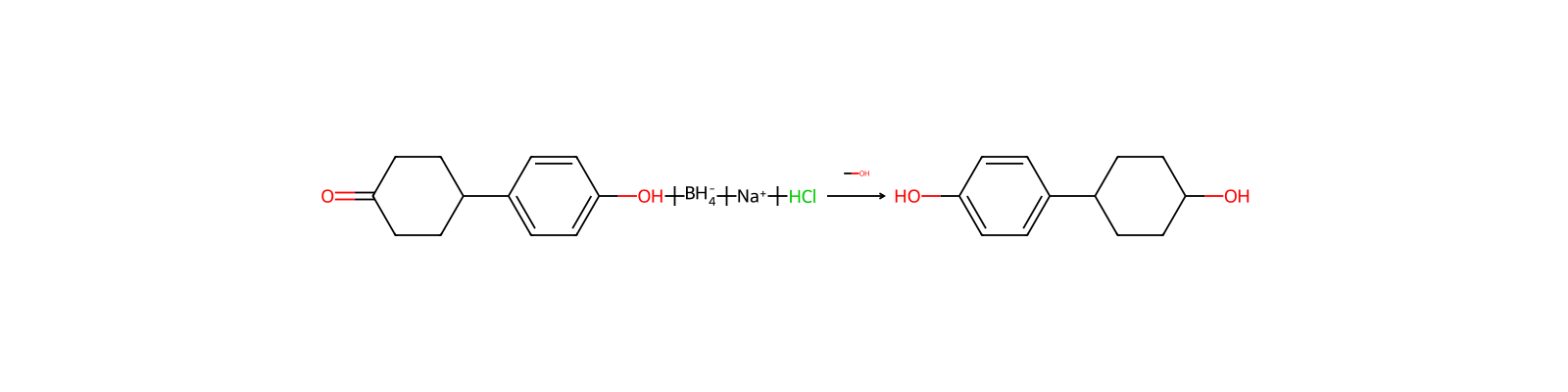
[OH:1][C:2]1[CH:7]=[CH:6][C:5]([CH:8]2[CH2:13][CH2:12][C:11](=[O:14])[CH2:10][CH2:9]2)=[CH:4][CH:3]=1.[BH4-].[Na+].Cl>CO>[OH:14][CH:11]1[CH2:10][CH2:9][CH:8]([C:5]2[CH:4]=[CH:3][C:2]([OH:1])=[CH:7][CH:6]=2)[CH2:13][CH2:12]1Participants
5
Reactant 3



Product 1

Reagents, catalysts & solvents 1

Procedure
10 g (0.052 mol) of 4-(4-Hydroxy-phenyl)-cyclohexanone is dissolved in 300 mL of methanol. 2.13 g (0.058 mol) of NaBH4 is added at room temperature by small portion for 2 hours. After stirring over night, the mixture is cooled using an ice-water bath, then hydrolysed with a solution of 10% HCl aqueous solution. The solution is extracted several times with ethyl acetate. The resulting organic phase is washed with water, dried over magnesium sulfate, then concentrated under reduced pressure. The residue recrystallised from ethanol gives pure white crystals (8.7 g, 87% yield).
Workup
- temperaturethe mixture is cooled
- extractionThe solution is extracted several times with ethyl acetate
- washThe resulting organic phase is washed with water
- dry with materialdried over magnesium sulfate
- concentrationconcentrated under reduced pressure
- customThe residue recrystallised from ethanol
Sources & evidence
- ORD record
- ord-d92ced5a02524aa68a92a454c1c763b7
- Source dataset
- uspto-grants-2008_08
- Patent number
- US07416682B2
Reaction notes
Loading…