1-Dodecanol → Dilauryl Ether
Reaction equation

[CH2:1](O)[CH2:2][CH2:3][CH2:4][CH2:5][CH2:6][CH2:7][CH2:8][CH2:9][CH2:10][CH2:11][CH3:12].[C:14](=[O:17])([O-])[O-].[Na+].[Na+]>C1(C)C=CC(S(O)(=O)=O)=CC=1>[CH2:1]([O:17][CH2:14][CH2:11][CH2:10][CH2:9][CH2:8][CH2:7][CH2:6][CH2:5][CH2:4][CH2:3][CH2:2][CH3:1])[CH2:2][CH2:3][CH2:4][CH2:5][CH2:6][CH2:7][CH2:8][CH2:9][CH2:10][CH2:11][CH3:12]Participants
4
Reactant 2
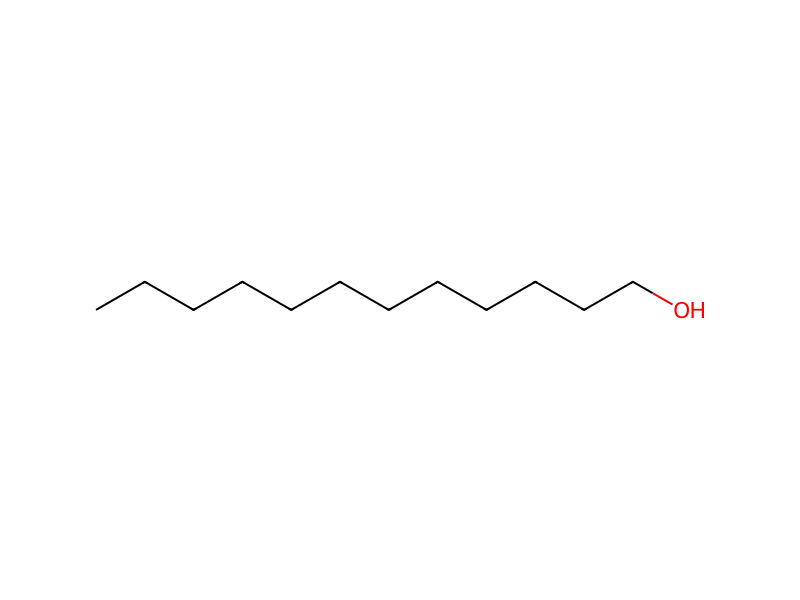

Product 1

Reagents, catalysts & solvents 1

Conditions
- Temperature
- 125 °C
Procedure
After placing 390 parts by weight of n-dodecanol into a reaction vessel and heating to 125° C., one part by weight of p-toluene sulfonic acid as a catalyst was added to the solution, and then the pressure in the vessel was reduced to 5-10 mmHg. Separately, 100 parts by weight of anhydrous crystalline cyclotetrasaccharide, obtained by the method in Example B-3, was suspended in 130 parts by weight of n-dodecanol. The suspension was added into the above vessel drop by drop in a flow rate of 2.3 parts by weight/min with taking a time of 100 min for the reaction. Successively, the reactant was neutralized with aqueous sodium carbonate solution, and cyclotetrasaccharide dodecyl ether was obtained by evaporating residual alcohol.
Workup
- additionThe suspension was added into the above vessel drop by drop in a flow rate of 2.3 parts by weight/min
- customa time of 100 min
- customfor the reaction
Sources & evidence
- ORD record
- ord-a5ec998d1d904bc99488f6ceaa5eceb1
- Source dataset
- uspto-grants-2008_05
- Patent number
- US07375095B2
Reaction notes
Loading…