Benzaldehyde → 4-(2-(Benzylamino)ethyl)phenol
Reaction equation

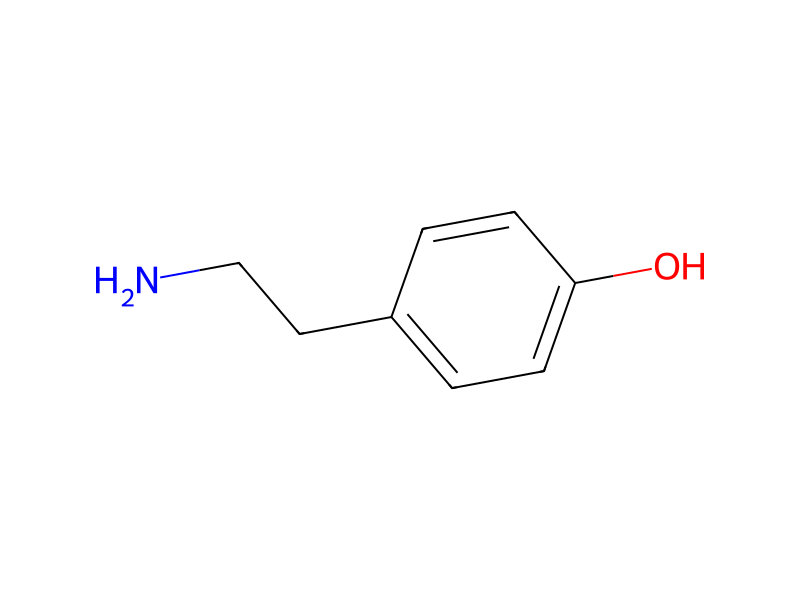
[NH2:1][CH2:2][CH2:3][C:4]1[CH:9]=[CH:8][C:7]([OH:10])=[CH:6][CH:5]=1.[CH:11](=O)[C:12]1[CH:17]=[CH:16][CH:15]=[CH:14][CH:13]=1>>[CH2:11]([NH:1][CH2:2][CH2:3][C:4]1[CH:9]=[CH:8][C:7]([OH:10])=[CH:6][CH:5]=1)[C:12]1[CH:17]=[CH:16][CH:15]=[CH:14][CH:13]=1Participants


Procedure
According to scheme 6, tyramine (1) is reacted with benzaldehyde under reductive amination conditions to yield 4-(2-benzylamino-ethyl)-phenol (28). The amine 28 is protected as the t-butyl carbamate (29). The carbamate 29 is reacted with 4-fluoronitrobenzene under basic reaction conditions (as shown or known modifications thereof) to afford the coupled product 30. The coupled product 30 is then reduced at the nitro group utilizing catalytic hydrogenation (palladium on carbon) to afford {2-[4-(4-amino-phenoxy)-phenyl]-ethyl}-benzyl-carbamic acid tert-butyl ester (31). The resulting amine 31 may be acylated with one of various acid chlorides to form the desired reverse amide compound 32. The Boc protecting group is removed with TFA in dichloromethane to afford compound 33, a compound of the invention.
Sources & evidence
- ORD record
- ord-8111d487436b4e9cbb4a830ff7c308b0
- Source dataset
- uspto-grants-2008_05
- Patent number
- US07378448B2
Reaction notes
Loading…