Pinacolone → HCID 12374801, compound
Reaction equation

[CH3:1][C:2](=[O:7])[C:3]([CH3:6])([CH3:5])[CH3:4].[CH:8](=[O:17])[CH2:9][CH2:10]CCCCCC.C([Mg]Cl)(C)(C)C.CC(C)(C(O)CCCCCCCC)C.CC(C)(C(=O)CCCCCCCC)C.O1C=CC=C1C=O>O.O.O.O.O.[OH-].[OH-].[Cr].[Cr]>[CH3:4][C:3]([CH3:6])([CH3:5])[CH:2]([C:1]1[O:17][CH:8]=[CH:9][CH:10]=1)[OH:7]Participants
Reactant 6
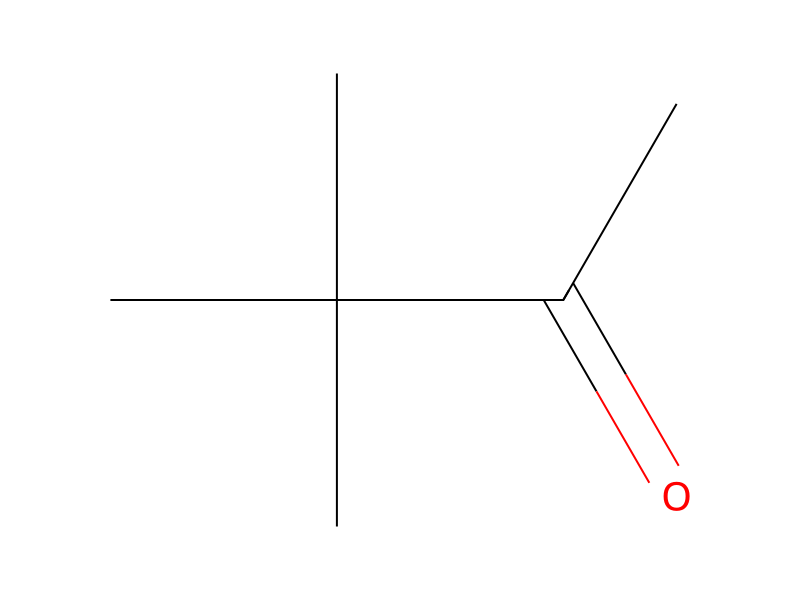


Product 1

Reagents, catalysts & solvents 1

Procedure
It should be noted that pinacolone 2a used in Examples 2 and 3 were purchased from Aldrich Chemical. Ketone 2b (2,2-dimethyl-3-undecanone) used in Example 4 was obtained by reacting 1-nonanal with tert-butyl magnesium chloride to synthesize 2,2-dimethyl-3-undecanol and oxidizing the resultant 2,2-dimethyl-3-undecanol with bichromic acid. Ketone 2c (pivalophenone(tert-butylphenyl ketone)) used in Example 5 was purchased from Aldrich Chemical. Ketone 2d (2,2-dimethyl-1-(2-furyl)-1-propanone) used in Example 6 was obtained by reacting 2-furaldehyde with tert-butyl magnesium chloride to yield 2,2-dimethyl-1-(2-furyl)-1-propanol and then oxidizing the resultant 2,2-dimethyl-1-(2-furyl)-1-propanol with N-methylmorpholine-N-oxide in the presence of a catalyst, TPAP (tetrapropylammonium perruthenate). Ketone 2e (2,2-dimethyl-1-(2-thienyl)-1-propanone) used in Example 7 was obtained by reacting thiophene with pivaloyl chloride in the presence of aluminum chloride. Ketone 2f (4,4-dimethyl-1-phenyl-3-pentenone) used in Example 8 was synthesized by a previously reported process (Org. Syn. Coll. Vol I, 81-82). Ketone 2g ((E)-2,2-dimethyl-4-undecen-3-one) used in Example 9 was obtained as a mixture with a ratio E/Z of 5:1 by reacting 1-bromo-3,3-dimethyl-2-butanone, which was obtained by bromination of pinacolone, with triphenylphosphine, treating the resultant product with sodium hydroxide to yield phosphorus ylide, and then reacting the resultant phosphorus ylide with 1-heptanal. Ketone 4a (ethyl 2,2-dimethyl-3-oxobutanoate) used in Example 10 was synthesized by a previously reported process (J. Am. Chem. Soc. 1988, vol 110, pp. 1539-1546). Ketone 4b (ethyl 2,2-dimethyl-3-oxo-3-phenyl propionate) used in Example 11 was also synthesized by a previously reported process (J. Chem. Soc., Perkin Trans. I 1986, pp. 1139-1143). Ketone 6 (adamantyl methyl ketone) used in Example 12 and ketone 7 (2,2-dimethylcyclohexanone) used in Example 13 were purchased from Aldrich Chemical. Ketone 8a (2,2-dimethyl-1-indanone) used in Example 14 and ketone 8b (2,2-dimethyl-1-tetralone) used in Example 15 were synthesized by previously reported processes (J. Am. Chem. Soc. 1975, vol. 97, pp. 4667-4672).
Workup
- customwas obtained
- customwas obtained
Sources & evidence
- ORD record
- ord-8070ab72746d4c9885cd9e8a4d95a2b8
- Source dataset
- uspto-grants-2008_05
- Patent number
- US07378560B2
Reaction notes
Loading…