Guanidine Hydrochloride → Pyrido[2,3-d]pyrimidine-6-carbonitrile, 2,4-diamino-5-methyl-
Reaction equation

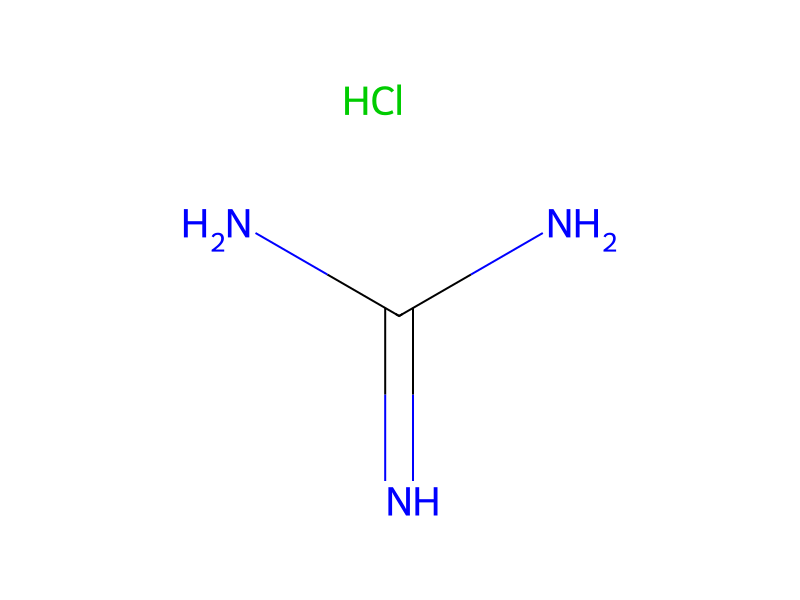
[NH2:1][C:2]1[N:3]=[C:4]([NH2:27])[C:5]2[C:11]([CH3:12])=[C:10]([CH2:13][NH:14]C3C=C(OC)C(OC)=C(OC)C=3)[CH:9]=[N:8][C:6]=2[N:7]=1.Cl.NC(N)=N>C(O)C>[NH2:1][C:2]1[N:3]=[C:4]([NH2:27])[C:5]2[C:11]([CH3:12])=[C:10]([C:13]#[N:14])[CH:9]=[N:8][C:6]=2[N:7]=1Participants
Reactant 2

Product 1

Reagents, catalysts & solvents 1

Conditions
- Temperature
- 25 °C
Procedure
Compound I was made in the following manner. Dried and pulverized guanidine hydrochloride (30.9 g; 0.323 mol.) was added to a solution prepared by dissolving Na metal (7.44 g; 0,323 mol.) in absolute ethyl alcohol (1.5 liter). This mixture was stirred rapidly at about 25° C. for about 30 minutes, and then 2-amino-3,5-dicarbonitrile-4-methylpyridine (24.7 g; 0.56 mol.) was added. The resulting mixture was refluxed with stirring for about seven days. The ethyl alcohol insoluble product (2,4-diamino-5-methylpyrido[2,3-d]pyrimidine-6-carbonitrile) and NaCl were filtered from the boiling mixture. The solid cake was then stirred with boiling ethyl alcohol, washed with hot water, ethyl alcohol and Et2O (ethyl ether) in that order to yield pure 2,4-diamino-5-methylpyrido[2,3-d]pyrimidine-6-carbonitrile in 65% yield and having a melting point greater than 300° C. A stirred solution of 2,4-diamino-5-methylpyrido[2,3-d]pyrimidine-6-carbonitrile (3.5 g; 17.5 mmol) and trimethoxyaniline (4.6; 2.51 mmol) in about 70% acetic acid (600 ml) containing damp Raney Ni (about 10 g) was kept under H2 at atmospheric pressure for about 24 hours. The mixture was then treated with Norit and filtered (celite mat). Acetic acid was removed from the filtrate by evaporation under reduced pressure (H2O aspirator, bath at 40° C.) with the aid of added portion of ethanol. Then a solution of the residue, in warm ethanol (20 ml), was added in a thin stream to a stirred saturated sodium carbonate solution (200 ml) at room temperature. The mixture was stirred at about 10° C. for about 20 minutes and the yellow precipitate that formed was collected, washed with H2O and dried. The crude product contained unchanged trimethoxyaniline, which was removed by repeated treatment with acetone and methanol (50 ml). The insoluble material was suspended and stirred in about 200 ml of ethanol for about 1 hour. The solid was collected by filtration, and dissolved in glacial acetic acid. The cloudy solution was clarified (using celite), concentrated, diluted with methanol (80 ml) and left for about 16 hours in a refrigerator when the desired product 2,4-diamino-5-methyl-6[[(3,4,5-trimethoxyphenyl)amino]methyl]pyrido[2,3-d]pyrimidine (Compound I) separated as a yellow solid (2.2 g) at a yield of 38.5%. 1HNMR δ 2.65(s, 3H, CH3), 3.56 (s,3H, OCH3), 3.67 (s, 6H, 20CH3), 4.17 (S,CH2, 2H), 5.66 (t, 1H, exchangeable), 5.93 (s, 2H, Ar-H), 6.21 (s, 2H, exchangeable), 6.99 (s,2H, exchangeable), 8.48 (s, 1H, aromatic H's). Microanalyses calculated for C18H22N6O3.0.4 CH3COOH.2H2O. C 52.46, H 6.46, N 19.52; Found C 52.60, H 6.22, N 19.71
Workup
- customDried
- additionwas added to a solution
- customprepared
- temperatureThe resulting mixture was refluxed
- stirringwith stirring for about seven days
- filtrationThe ethyl alcohol insoluble product (2,4-diamino-5-methylpyrido[2,3-d]pyrimidine-6-carbonitrile) and NaCl were filtered from the boiling mixture
- stirringThe solid cake was then stirred with boiling ethyl alcohol
- washwashed with hot water, ethyl alcohol and Et2O (ethyl ether) in that order
Sources & evidence
- ORD record
- ord-8af293645227425db505cece3cee8bcb
- Source dataset
- uspto-grants-1994_09
- Patent number
- US05346900
Reaction notes
Loading…