Propargyl bromide → HCID 18966549, compound
Reaction equation

[CH2:1]([N:4]1[C:8](=[O:9])[C:7]([CH3:11])([CH3:10])[NH:6][C:5]1=[O:12])[C:2]#[CH:3].C([O-])([O-])=O.[K+].[K+].[CH2:19](Br)[C:20]#[CH:21]>C(C(C)=O)C.O>[CH2:21]([N:6]1[C:7]([CH3:10])([CH3:11])[C:8](=[O:9])[N:4]([CH2:1][C:2]#[CH:3])[C:5]1=[O:12])[C:20]#[CH:19]Participants
6
Reactant 3
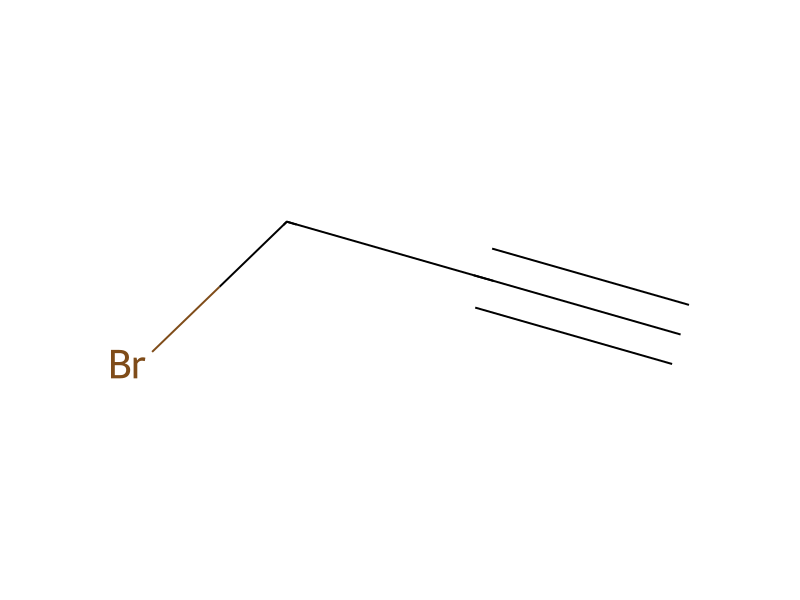


Product 1

Reagents, catalysts & solvents 2


Procedure
To a stirred solution of 3-(2-propynyl)-5,5-dimethylhydantoin (3 g, 18.1 mmole) in methyl ethyl ketone (125 mL) at room temperature was added K2CO3 (2.8 g, 20.3 mmole), followed by propargyl bromide (3 g, 80% in toluene, 20.2 mmole). The reaction mixture was then refluxed for 24 hr. The reaction mixture was cooled to room temperature and was diluted with water and extracted with methylene chloride (3×125 mL). The organic layer was washed with saturated NaCl and dried over MgSO4. Evaporation of the volatiles yielded 3.3 g (89 %) of 1,3-di-propargyl-5,5-dimethylhydantoin as a light yellow semi-solid. An NMR spectrum showed the desired structure. This intermediate was subjected to the next step without further purification.
Workup
- temperatureThe reaction mixture was then refluxed for 24 hr
- extractionextracted with methylene chloride (3×125 mL)
- washThe organic layer was washed with saturated NaCl
- dry with materialdried over MgSO4
- customEvaporation of the volatiles
Sources & evidence
- ORD record
- ord-2b18fe3bf8404e2fa55c9b3e9b7b1a23
- Source dataset
- uspto-grants-1994_09
- Patent number
- US05346913
Reaction notes
Loading…