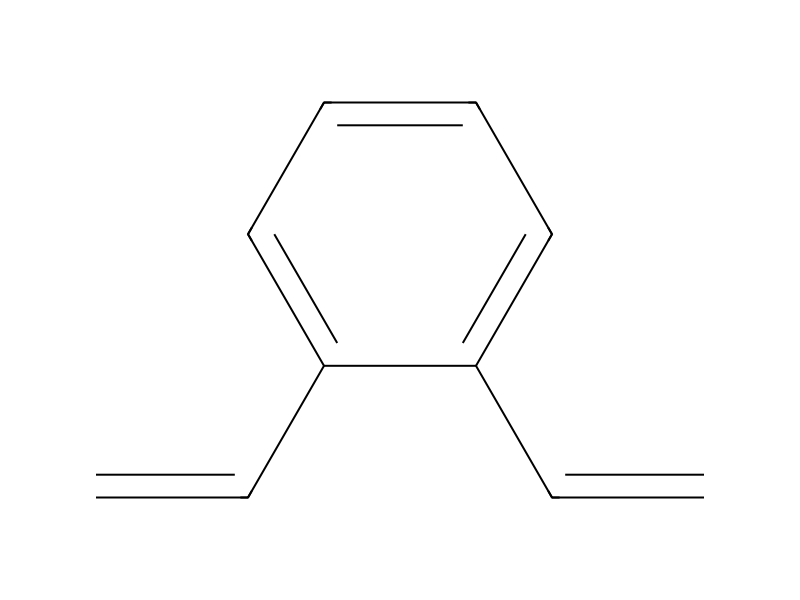
Benzene → p-Divinylbenzene
Reaction equation

C([C:3]1[CH:8]=[CH:7][CH:6]=[CH:5][C:4]=1[CH:9]=[CH2:10])=C.BrBr.[CH:13]1C=CC=C[CH:14]=1>>[CH:9]([C:4]1[CH:3]=[CH:8][C:7]([CH:13]=[CH2:14])=[CH:6][CH:5]=1)=[CH2:10]Participants



Conditions
- Temperature
- 0 °C
Procedure
Pure 1,4-divinylbenzene (1,4-DVB) monomer was isolated from commercially available divinylbenzene mixture (Aldrich Chemical Co.), containing about 60 wt. % divinylbenzene and having a mole ratio between the 1,3- and 1,4-isomer of about 1 to 2.5, by a bromination-debromination method. In a 1 L flask equipped with a magnetic stirring bar, 230 ml of the commercial divinylbenzene mixture was mixed with 500 ml of benzene. Under stirring and cooling at 0° C., 120 ml of bromine was dropwised into the mixed solution for a period of 6 hours. During the bromine addition, the color of solution changed from deep red through brown yellow to light yellow. At the last stage, the tetrabromided 1,4-divinylbenzene was crystallized and the solution became gray white. The crystals were filtered and washed with methanol until complete decoloration. The resulting crystals were recrystallized twice from chloroform, filtered and dried. About 95 g of the tetrabromided 1,4-divinylbenzene, i.e. 1,4-bis(1,2-dibromoethyl)benzene, was obtained. The crystals were analyzed by DSC and NMR. DSC showed a melting point at 163° C. 1H NMR spectra showed the expected chemical shifts: 67 =7.45 (singlet, 4H, C6H4), 5.15 (multiplet, 2H, CHBrCH2Br), and 4.10 (multiplet, 4H, CHBrCH2Br).
Workup
- customIn a 1 L flask equipped with a magnetic stirring bar
- customAt the last stage, the tetrabromided 1,4-divinylbenzene was crystallized
- filtrationThe crystals were filtered
- washwashed with methanol until complete decoloration
- customThe resulting crystals were recrystallized twice from chloroform
- filtrationfiltered
- customdried
Sources & evidence
- ORD record
- ord-89f037b77718411faafb4e2cffd418a9
- Source dataset
- uspto-grants-2002_07
- Patent number
- US06414102B1
Reaction notes
Loading…