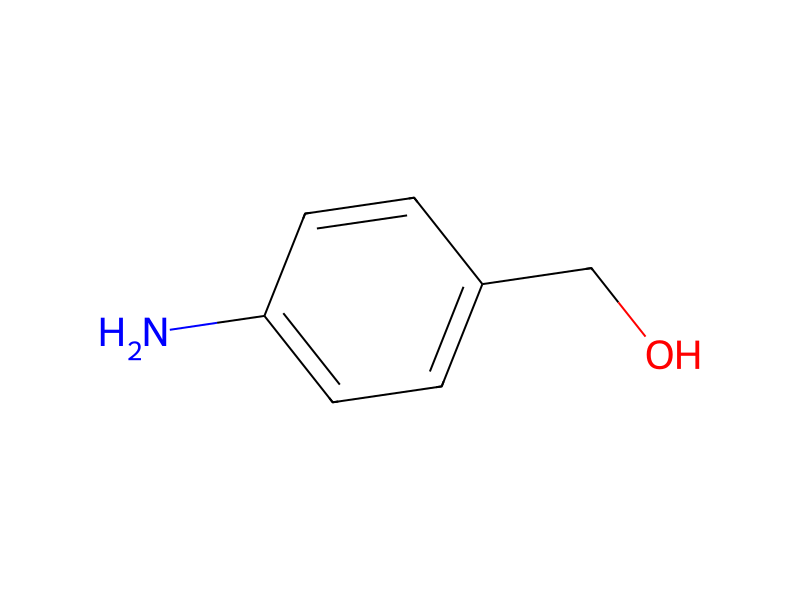
4-Nitrobenzyl alcohol → 4-Aminobenzyl alcohol
Reaction equation

[N+:1]([C:4]1[CH:11]=[CH:10][C:7]([CH2:8][OH:9])=[CH:6][CH:5]=1)([O-])=O.B.[K]>CO.[Cu](Cl)Cl>[NH2:1][C:4]1[CH:11]=[CH:10][C:7]([CH2:8][OH:9])=[CH:6][CH:5]=1Participants
5
Reactant 2


Product 1
Reagents, catalysts & solvents 2


Procedure
To a solution of 4-nitrobenzylalcohol (4.59 g) in methanol (300 ml) was added copper chloride (I) (17.8 g) at room temperature, and then was gradually added potassium boron hydride (11.3 g) for 40 minutes. The reaction mixture was stirred at room temperature for 2 hours and concentrated under reduced pressure. To the residue was added water, and the mixture was extracted with ethyl acetate. The organic layer was dried with anhydrous sodium sulfate, and concentrated under reduced pressure. The residue was separated and purified with column chromatography (ethyl acetate/hexane=3/1) to give 4-aminobenzylalcohol (1.31 g) as pale yellow crystals.
Workup
- customfor 40 minutes
- concentrationconcentrated under reduced pressure
- additionTo the residue was added water
- extractionthe mixture was extracted with ethyl acetate
- dry with materialThe organic layer was dried with anhydrous sodium sulfate
- concentrationconcentrated under reduced pressure
- customThe residue was separated
- custompurified with column chromatography (ethyl acetate/hexane=3/1)
Sources & evidence
- ORD record
- ord-c42388019894437390558d9d5fbf79a1
- Source dataset
- uspto-grants-2002_07
- Patent number
- US06413947B1
Reaction notes
Loading…