
4-Aminobenzyl alcohol
Completing data — refresh the page later to see the latest
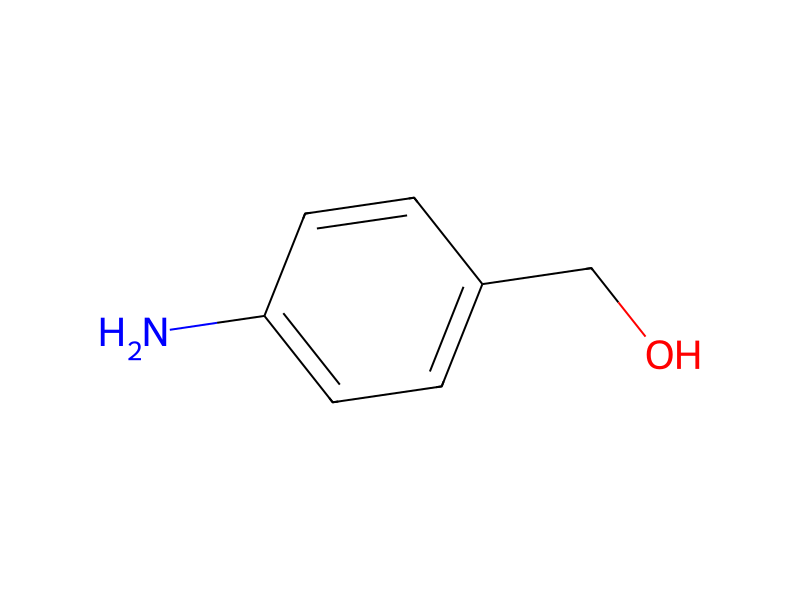
Basic information
- CAS
623-04-1- Standard SMILES
Nc1ccc(CO)cc1- InChIKey
AXKGIPZJYUNAIW-UHFFFAOYSA-N- Molecular formula
- C7H9NO
- Average molar mass
- 123.15 g/mol
- Monoisotopic mass
- 123.06841391
Overview
structure
Names & identifiers
- Preferred name
- 4-Aminobenzyl alcohol
- IUPAC
- (4-aminophenyl)methanol
- English name
- 4-Aminobenzyl alcohol
- Molecular formula
- C7H9NO
- Molecular weight
- 123.15
Names & synonyms
4-Aminobenzyl alcohol623-04-1p-Aminobenzyl alcoholRRK8Y5LEQ2DTXSID20211353RefChem:97839DTXCID20133844210-767-5(4-Aminophenyl)methanolBenzenemethanol, 4-amino-4-(Hydroxymethyl)aniline4-Aminobenzylalcohol
Show more names
4-AminobenzyL4-Aminobenzyl alcohoAMinobenzeneMethanolBenzocaine impurity Ap-Aminobenzenecarbinol4-Aminobenzenemethanol4-AminobenzylAlcohol>
P-aminobenzylalcoholMFCD00014782Benzocaine EP Impurity ABenzyl alcohol, p-amino-4-aminophenylmethanol4-hydroxymethylphenylamine(4-amino phenyl)methanolCK2439
Database identifiers
- CAS
623-04-1- PubChem CID
- 69331
- DTXSID
DTXSID20211353- ChEMBL
CHEMBL4087737- UNII
- RRK8Y5LEQ2
- EC Number
- 210-767-5
- Nikkaji
- J133.617G
Properties
Computed structural propertiesFilling in
- XLogP
- -0.2
- Topological polar surface area
- 46.3 Ų
- Hydrogen bond donors
- 2
- Hydrogen bond acceptors
- 2
- Rotatable bonds
- 1
- Heavy atoms
- 9
- Formal charge
- 0
- Complexity
- 77
Experimental & physicochemical properties
SpringerMaterials Properties13C nuclear magnetic resonance spectrum
LogP-0.22
Physicochemical properties
- Melting point
- 60 · 60-65 °C(lit.)
- Boiling point
- 171 °C/11mmHg · 171°C/11mmHg(lit.)
- Density
- 1.0877 · 1.0877 (rough estimate)
- refractive index
- 1.538 · 1.5380 (estimate)
- storage temp.
- 2 · 2-8°C
- solubility
- Chloroform (Soluble), Methanol (Slightly)
- form
- Crystalline Powder
- pka
- 14.82 · 14.82±0.10(Predicted)
- color
- Yellow to brown
- Water Solubility
- Soluble in alcohol, ether and benzene. Partially soluble in water.
- Sensitive
Safety & regulation
Safety information is for reference only and does not replace the supplier’s Safety Data Sheet (SDS), applicable regulations, or professional assessment.
GHS classification
GHS Classification
Warning
H302 (13.7%): Harmful if swallowed [Warning Acute toxicity, oral]
P261, P264, P264+P265, P270, P271, P280, P301+P317, P302+P352, P304+P340, P305+P351+P338, P319, P321, P330, P332+P317, P337+P317, P362+P364, P403+P233, P405, and P501 (click each P-code to see the statement)
Aggregated GHS information provided per 51 reports by companies from 10 notifications to the ECHA C&L Inventory. Each notification may be associated with multiple companies.
Hazard information
Hazard Classes and CategoriesAcute Tox. 4 (13.7%)
Safety data
- F
- 4.7-8-10-23
- PPE
- dust mask type N95 (US), Eyeshields, Gloves
- wgk
- 3
- hs_code
- 2922199090
- risk_code
- 36/37/38-20/21/22
- Signal word
- Warning
- Symbol(GHS)
- GHS07
- hazard_code
- Xi,Xn
- hazard_note
- Irritant
- safety_code
- 26-36-37/39
- Storage Class
- 11 - Combustible Solids
- target organs
- Respiratory system
- Hazard statements
- H315-H319-H335
- Hazard Classifications
- Eye Irrit. 2Skin Irrit. 2STOT SE 3
Chemistry & industry
Applications
Uses4-Aminobenzyl alcohol is used in the synthesis of 4-{N-[1-(4,4-dimethyl-2,6-dioxocyclohexylidene)-3-methylbutylamino}benzyl ester. It is also used as an intermediate in organic synthesis and pharmaceutical products.
Upstream & downstream products
Upstream raw materials
Downstream products
Related reactions
143 records



Compound notes
Loading…