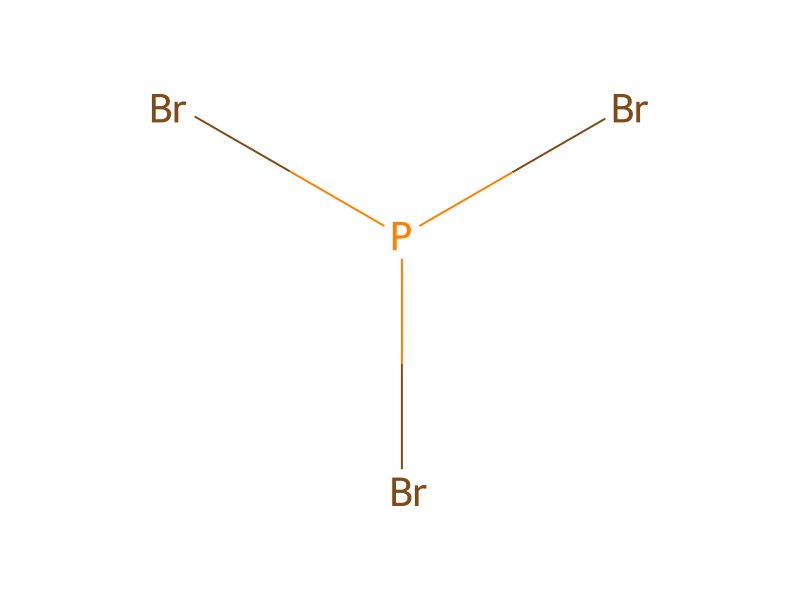
Phosphorus tribromide → HCID 18470429, compound
Reaction equation

[Cl:1][C:2]1[CH:3]=[C:4]([C:9]#[C:10][CH2:11][CH2:12][CH2:13][CH2:14][CH2:15][CH2:16]O)[CH:5]=[CH:6][C:7]=1[Cl:8].P(Br)(Br)[Br:19].C(=O)([O-])O.[Na+]>C(OCC)C>[Br:19][CH2:16][CH2:15][CH2:14][CH2:13][CH2:12][CH2:11][C:10]#[C:9][C:4]1[CH:5]=[CH:6][C:7]([Cl:8])=[C:2]([Cl:1])[CH:3]=1Participants
Reactant 3


Product 1

Reagents, catalysts & solvents 1

Conditions
- Temperature
- 2.5 °C
Procedure
A solution of 8-(3,4-dichlorophenyl)-oct-7-yn-1-ol (0.52 g) in diethyl ether (2.5 ml) was treated with phosphorous tribromide (0.23 g) at 0° C. (ice/salt bath). The solution was stirred at 0-5° C. for 2 h and allowed to warm to room temperature. Aqueous sodium hydrogen carbonate solution was added. The aqueous layer was extracted with further diethyl ether (2×5 ml) and the combined organic layers were washed with brine (5 ml) and dried over magnesium sulfate. Removal of the solvent under reduced pressure gave an oil that was chromatographed on silica gel using dichloromethane as eluent. This gave 8-bromo-1-(3,4-dichlorophenyl)-1-octyne (0.25 g). 1H-NMR (CDCl3) δ 1.35-1.7 (6H, m), 1.75-1.95 (2H, m), 2.33 (2H, t), 3.35 (2H, t), 7.13 (1H, dd), 7.27 (1H, d) and 7.40 (1H, d).
Workup
- temperatureto warm to room temperature
- extractionThe aqueous layer was extracted with further diethyl ether (2×5 ml)
- washthe combined organic layers were washed with brine (5 ml)
- dry with materialdried over magnesium sulfate
- customRemoval of the solvent under reduced pressure
- customgave an oil that
- customwas chromatographed on silica gel
Sources & evidence
- ORD record
- ord-60664a844f6f4155bb718a7cb0c94048
- Source dataset
- uspto-grants-2002_07
- Patent number
- US06417192B1
Reaction notes
Loading…