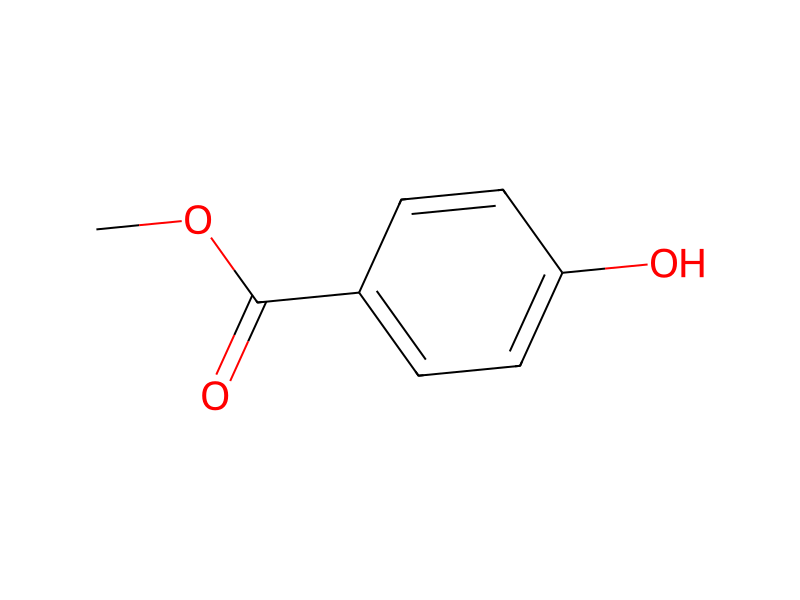
Methylparaben → 4-(4-Hydroxybutoxy)benzoic acid
Reaction equation

C([O:4][CH2:5][CH2:6][CH2:7][CH2:8]Cl)(=O)C.[OH:10][C:11]1[CH:20]=[CH:19][C:14]([C:15]([O:17]C)=[O:16])=[CH:13][CH:12]=1>>[OH:4][CH2:5][CH2:6][CH2:7][CH2:8][O:10][C:11]1[CH:20]=[CH:19][C:14]([C:15]([OH:17])=[O:16])=[CH:13][CH:12]=1Participants
3


Procedure
The 4-hydroxyphenyl acrylate required can be obtained by selective monocleavage of hydroquinone bisacrylate using sodium methoxide analogously to DE 44 42 831 (corresponds to U.S. Pat. No. 5,654,471) in a yield of 91%. The monoacrylate is liquid at room temperature. The acid component to the above ester, 4-(4-acryloyloxybutoxy)benzoic acid, can be obtained by reacting 4-chlorobutyl acetate with methyl 4-hydroxybenzoate, hydrolyzing the resultant alkylated methyl ester to give free 4-(4-hydroxybutoxy)benzoic acid, and esterifying the latter on the hydroxybutoxy radical using acrylic acid. This acid melts at 124° C. (yield 70%) and can be converted into the acid chloride by conventional reaction with thionyl chloride.
Sources & evidence
- ORD record
- ord-6b9fc2eedd004a0dadb7f12d1c47bee6
- Source dataset
- uspto-grants-2002_07
- Patent number
- US06423246B1
Reaction notes
Loading…