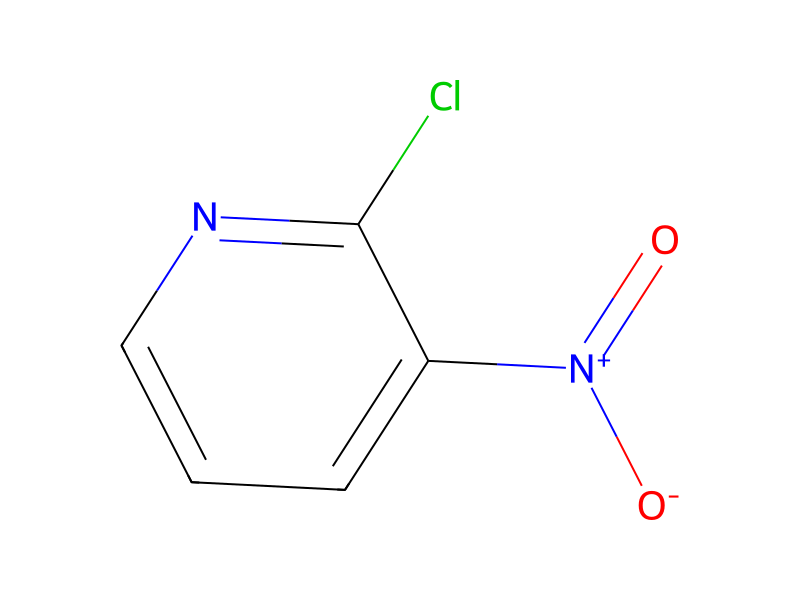
2-Chloro-3-nitropyridine → HCID 44120582, compound
Reaction equation

[C:1]([O:5][C:6](=[O:14])[NH:7][CH:8]1[CH2:13][CH2:12][NH:11][CH2:10][CH2:9]1)([CH3:4])([CH3:3])[CH3:2].Cl[C:16]1[C:21]([N+:22]([O-:24])=[O:23])=[CH:20][CH:19]=[CH:18][N:17]=1>CN1C(=O)CCC1>[N+:22]([C:21]1[C:16]([N:11]2[CH2:12][CH2:13][CH:8]([NH:7][C:6](=[O:14])[O:5][C:1]([CH3:4])([CH3:2])[CH3:3])[CH2:9][CH2:10]2)=[N:17][CH:18]=[CH:19][CH:20]=1)([O-:24])=[O:23]Participants
4
Reactant 2

Product 1

Reagents, catalysts & solvents 1

Procedure
Anhydrous TEA (0.76 ml, 5.49 mmol) was added to piperidin-4-yl-carbamic acid tert-butyl ester (1 g, 5 mmol) and 2-chloro-3-nitro-pyridine (0.791 g, 5 mmol) in anhydrous NMP (3 ml). Using a Smith Microwave Synthesizer, the mixture was subjected to single-mode microwave at 150° C. for 10 minutes. The brown solution was partitioned between EtOAc and water and the organic phase was washed several times with water, dried over sodium sulphate and concentrated in vacuo to give the title compound as a yellow solid (1.35 g).
Workup
- customat 150° C.
- customfor 10 minutes
- customThe brown solution was partitioned between EtOAc and water
- washthe organic phase was washed several times with water
- dry with materialdried over sodium sulphate
- concentrationconcentrated in vacuo
Sources & evidence
- ORD record
- ord-3fa3454866764ee1a3b191f0da1e0b2e
- Source dataset
- uspto-grants-2010_05
- Patent number
- US07709503B2
Reaction notes
Loading…