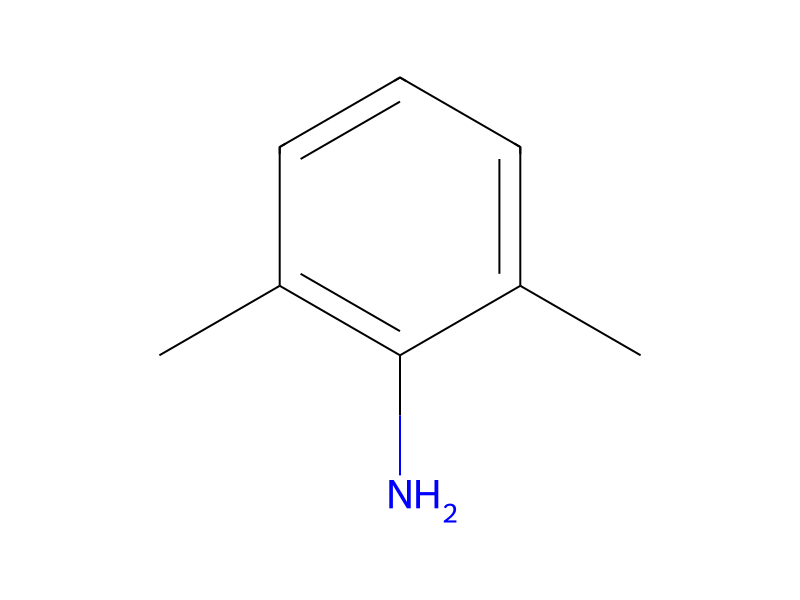
Ammonia → 2,6-Dimethylaniline
Reaction equation

[NH3:1].[H][H].[CH3:4][CH:5]1[CH2:10][CH2:9][CH2:8][CH:7]([CH3:11])[CH:6]1[OH:12].[CH3:13][CH:14]1[CH2:19][CH2:18][CH2:17][CH:16]([CH3:20])[C:15]1=[O:21]>[Pd].[Zn]>[CH3:4][CH:5]1[CH2:10][CH2:9][CH2:8][CH:7]([CH3:11])[CH:6]1[OH:12].[CH3:13][CH:14]1[CH2:19][CH2:18][CH2:17][CH:16]([CH3:20])[C:15]1=[O:21].[CH3:4][C:5]1[CH:10]=[CH:9][CH:8]=[C:7]([CH3:11])[C:6]=1[NH2:1]Participants






Procedure
1,000 parts by volume of catalyst are introduced into a fluidised bed reactor having a capacity of 1.2 liters, corresponding to 1,200 parts by volume. The catalyst consists of 0.5% by weight of palladium and 0.2% by weight of zinc on Al2O3 and has a particle size of 0.2 to 0.6 mm. The temperature in the reactor is set to 220° C. and, per hour, a correspondingly preheated mixture of 200,000 parts by volume of ammonia and 200,000 parts by volume of hydrogen is introduced. 50 parts of a mixture consisting of 80% by weight of 2,6-dimethylcyclohexanol and 20% by weight of 2,6-dimethylcyclohexanone is passed continuously, per hour, through the fluidised catalyst bed thus produced. The reaction product is isolated by cooling the exit gases, and is distilled. 100 parts of 2,6-dimethylcyclohexanol/2,6-dimethylcyclohexanone mixture employed give 92 parts of 2,6-dimethylaniline. Yield: 96.5%.
Workup
- addition1,000 parts by volume of catalyst are introduced into a fluidised bed reactor
- waitThe temperature in the reactor is set to 220° C. and, per hour
- additionis introduced
- waitis passed continuously, per hour, through the fluidised catalyst bed
- customthus produced
- customThe reaction product is isolated
- temperatureby cooling the exit gases
- distillationis distilled
Sources & evidence
- ORD record
- ord-782a3656fbcc4dd5991399f8e24c9d81
- Source dataset
- uspto-grants-1982_10
- Patent number
- US04355180
Reaction notes
Loading…