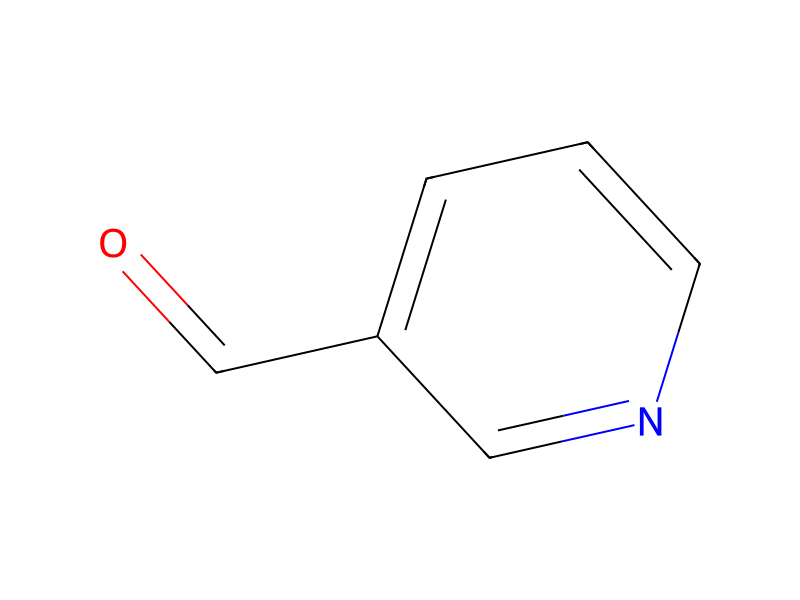
3-Pyridinecarboxaldehyde → 5-Oxo-1-(3-pyridinylmethyl)proline
Reaction equation

[NH2:1][C@@H:2]([C:8]([OH:10])=[O:9])[CH2:3][CH2:4][C:5]([OH:7])=O.[OH-].[Na+].[N:13]1[CH:18]=[CH:17][CH:16]=[C:15]([CH:19]=O)[CH:14]=1.[BH4-].[Na+]>C(O)C>[O:7]=[C:5]1[N:1]([CH2:19][C:15]2[CH:14]=[N:13][CH:18]=[CH:17][CH:16]=2)[C@H:2]([C:8]([OH:10])=[O:9])[CH2:3][CH2:4]1Participants
Reactant 4



Product 1

Reagents, catalysts & solvents 1

Procedure
D-glutamic acid (2.21 g, 15 mmol) was dissolved in 2N aqueous sodium hydroxide (15 ml, 30 mmol) at 0° C. and then treated with pyridine-3-carboxaldehyde (1.41 ml, 15 mmol) in ethanol (3 ml). The mixture was stirred at room temperature for 30 minutes and then cooled to 0° C. and treated portion-wise with sodium borohydride (0.189 g, 5 mmol). The mixture was allowed to warm to room temperature with stirring over 4 hrs then after washing with diethyl ether it was acidified to pH5-6 using concentrated hydrochloric acid. The resulting precipitate was collected by filtration, washed with diethyl ether, and dried in vacuo. This material was then taken up in ethanol (50 ml) and refluxed overnight. Fine solids were removed by filtration and then concentration gave 5-oxo-1-(3-pyridinylmethyl)proline (2.04 g) as a white solid which was used without any further purification.
Workup
- temperaturecooled to 0° C.
- temperatureto warm to room temperature
- stirringwith stirring over 4 hrs
- washafter washing with diethyl ether it
- filtrationThe resulting precipitate was collected by filtration
- washwashed with diethyl ether
- customdried in vacuo
- temperaturerefluxed overnight
- customFine solids were removed by filtration
- concentrationconcentration
Sources & evidence
- ORD record
- ord-08b6525927b24a1cbf1cdbb5737e86e7
- Source dataset
- uspto-grants-2010_05
- Patent number
- US07718693B2
Reaction notes
Loading…