Potassium Iodide → HCID 23332491, compound
Reaction equation

[N+:1]([C:4]1[CH:9]=[C:8]([NH:10][C:11]([CH3:13])=[O:12])[CH:7]=[CH:6][C:5]=1[OH:14])([O-:3])=[O:2].[Br:15][CH2:16][CH2:17][CH2:18][CH2:19]Br.C(=O)([O-])[O-].[K+].[K+].[I-].[K+]>CS(C)=O.CC(C)=O.O>[N+:1]([C:4]1[CH:9]=[C:8]([NH:10][C:11]([CH3:13])=[O:12])[CH:7]=[CH:6][C:5]=1[O:14][CH2:19][CH2:18][CH2:17][CH2:16][Br:15])([O-:3])=[O:2]Participants







Procedure
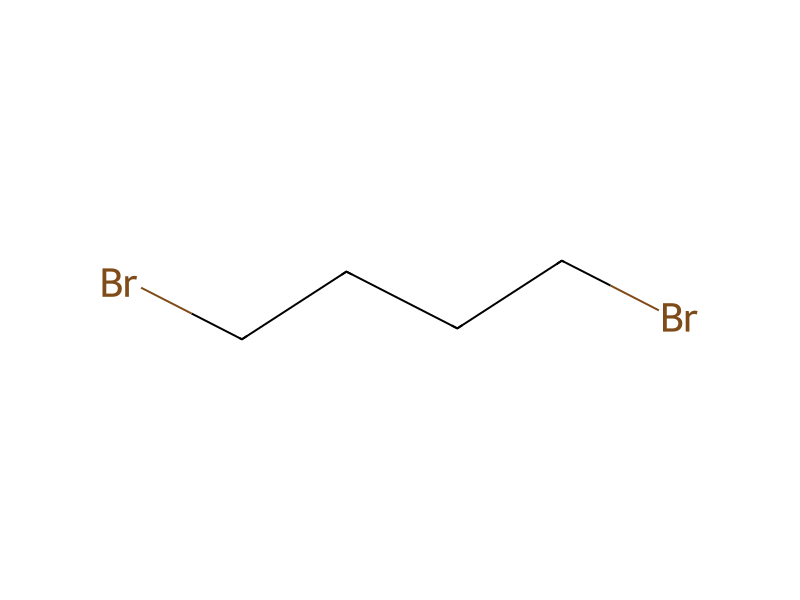
39.2 g of 2-nitro-4-acetamino-phenol are dissolved in a mixture of 200 ml of dimethylsulfoxide and 400 ml of acetone and, after adding 23.8 g of 1,4-dibromobutane, 13.8 g of potassium carbonate and 0.1 g of potassium iodide, the solution is boiled under reflux cooling for 10 hours, whilst stirring, and the reaction mixture is discharged onto 5 times the volume of water. The resulting yellow precipitate is filtered off, washed first with 1% strength sodium hydroxide solution and then with water and dried in vacuo at about 60° C. A small amount of 4-(2'-nitro-4'-acetamino-phenoxy)-1-bromobutane, formed by condensation on one side, is removed by boiling up with ethyl acetate. A yellow crystalline powder remains which consists of 1,4-bis-(2-nitro-4-acetamino-phenoxy)-butane and melts at 224°-226° C., with partial decomposition. In order to split off the acetyl groups, 10 g of the resulting diacetyl compound are suspended in 200 ml of ethanol and the suspension is boiled under reflux for 5 hours, whilst passing a stream of hydrogen chloride through. The resulting white suspension is poured onto 2,000 ml of water, the mixture is heated to the boil, a slight residue is filtered off and the filtrate is rendered alkaline with sodium hydroxide solution, whilst still hot. The orange-colored precipitate is filtered off and dried in vacuo at about 70° C. An orange-colored powder is obtained which melts at 192°-194° C., with partial decomposition. Analytically pure 1,4-bis-(2-nitro-4-amino-phenoxy)-butane is obtained in the form of a yellow-red crystalline powder on dissolving and reprecipitating from dimethylformamide/methanol. It melts at 194°-196° C., with partial decomposition.
Workup
- temperatureunder reflux
- temperaturecooling for 10 hours
- filtrationThe resulting yellow precipitate is filtered off
- washwashed first with 1% strength sodium hydroxide solution
- dry with materialwith water and dried in vacuo at about 60° C
Sources & evidence
- ORD record
- ord-b46dd1f0d345459bb0efc01f2a9d44c7
- Source dataset
- uspto-grants-1980_11
- Patent number
- US04231964
Reaction notes
Loading…