Formaldehyde → HCID 19994583, compound
Reaction equation

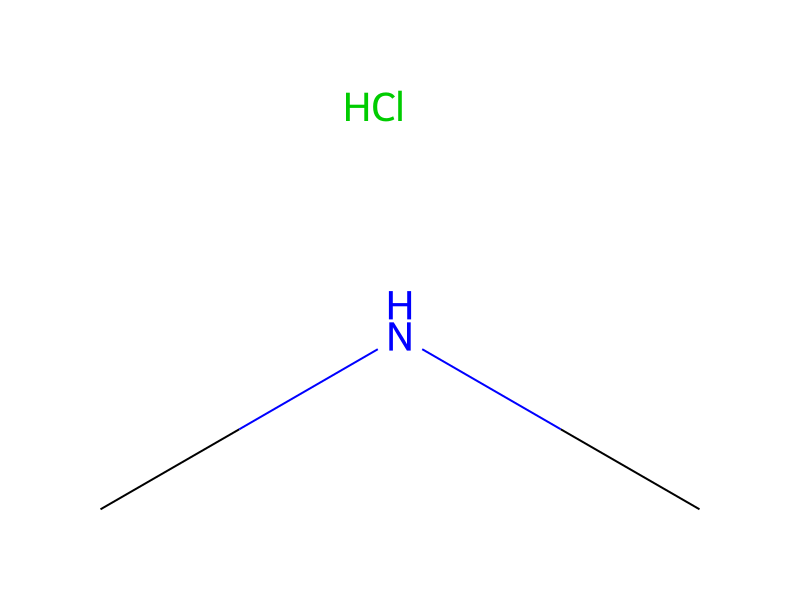
[CH2:1]=O.Cl.[CH3:4][NH:5][CH3:6].[C:7]1([CH2:13][CH2:14][C:15]2[C:16]3[N:17]([CH:21]=[CH:22][CH:23]=3)[CH:18]=[CH:19][N:20]=2)[CH:12]=[CH:11][CH:10]=[CH:9][CH:8]=1.[OH-].[Na+]>CC#N>[CH2:12]([C:7]1[CH:13]=[C:14]([C:15]2[C:16]3[N:17]([C:21]([CH2:4][N:5]([CH3:1])[CH3:6])=[CH:22][CH:23]=3)[CH:18]=[CH:19][N:20]=2)[CH:10]=[CH:9][CH:8]=1)[CH3:11]Participants
Reactant 4



Product 1

Reagents, catalysts & solvents 1

Conditions
- Temperature
- -78 °C
Procedure
A 500 mL round bottom flask was half-filled with paraformaldehyde (~200 g) and then connected by means of a rubber hose to an acetone-dry ice trap. The trap was fitted with a 100 mL round bottom flask that contained dry dimethylamine hydrochloride (880 mg, 18 mmol. 1.2 eq. with respect to 1-(2-phenylethyl)pyrrolo[1,2-a]pyrazine). The flask containing the dimethylamine hydrochloride was then cooled to -78° C. and the flask containing the paraformaldehyde was heated between 180°-200° C. until an excess of paraformaldehyde had been distilled. The reaction mixture was then allowed to warm to room temperature. The solid mixture was cooled again to -20° C. and a solution of 1-(2-phenylethyl)pyrrolo[1,2-a]pyrazine (2 g., 9 mmol) in 20 mL of dry CH3CN was added. The reaction mixture was allowed to reach room temperature and left stirring at this temperature for 8 hours. A solution of NaOH (5M, 40 mL) was then added. The resulting solution was extracted with ethyl acetate (3×30 mL). The organic extracts were extracted with a solution of HCl (0.1M, 50 mL). The aqueous acid phase was then separated, neutralized with a solution of NaOH (2M, 50 mL) and extracted with ethyl acetate (2×50 mL). The organic extracts were combined, dried over MgSO4 and evaporated to give 1.8 g (73%) of the title compound,
Workup
- customconnected by means of a rubber hose to an acetone-dry ice trap
- customThe trap was fitted with a 100 mL round bottom flask that
- distillationhad been distilled
- temperatureto warm to room temperature
- temperatureThe solid mixture was cooled again to -20° C.
- customto reach room temperature
- waitleft
- extractionThe resulting solution was extracted with ethyl acetate (3×30 mL)
- extractionThe organic extracts were extracted with a solution of HCl (0.1M, 50 mL)
- customThe aqueous acid phase was then separated
- extractionextracted with ethyl acetate (2×50 mL)
- dry with materialdried over MgSO4
- customevaporated
Sources & evidence
- ORD record
- ord-709a201e57814a6ab05c31a461a0e77e
- Source dataset
- uspto-grants-1991_08
- Patent number
- US05041442
Reaction notes
Loading…