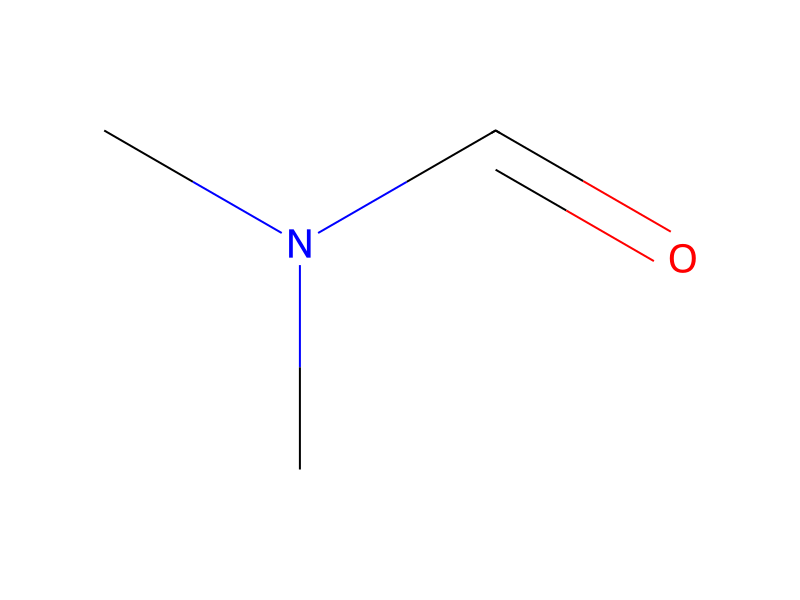
Dimethylformamide → 2-Dimethylaminomethylene-4-acetamidocyclohexanone
Reaction equation

[C:1]([NH:4][CH:5]1[CH2:10][CH2:9][C:8](=[O:11])[CH2:7][CH2:6]1)(=[O:3])[CH3:2].[CH3:12][N:13]([CH3:16])[CH:14]=O>>[CH3:12][N:13]([CH:16]=[C:9]1[CH2:10][CH:5]([NH:4][C:1](=[O:3])[CH3:2])[CH2:6][CH2:7][C:8]1=[O:11])[CH3:14]Participants


Procedure
According to Reaction Scheme I, 4-acetamido cyclohexanone, prepared by the procedure of Fraser and Swingle, Can. J. Chem., 48, 2065 (1970) is reacted with the dimethylacetal of dimethylformamide to yield 2-dimethylaminomethylene-4-acetamidocyclohexanone (III). Reacting this compound with sodium glycinate followed by a ring closure reaction in the presence of acetic anhydride yields, when R3 is methyl, dl-2-acetyl-5-acetamido-4,5,6,7-tetrahydro-2H-benzo[c]-pyrrole (IV). Treatment of this latter compound with base gives dl-5-amino-4,5,6,7-tetrahydro-2H-benzo[c]pyrrole (V). This latter compound can be preferentially alkylated on the amino group at C-5 using a reductive alkylation procedure; i.e., reaction with an aldehyde (formaldehyde, acetaldehyde, acrolein, or propionaldehyde) in the presence of a strong organometallic reducing agent such as sodium cyanoborohydride. The dialkylated compound, for instance, dl-5-di(n-propyl)amino-4,5,6,7-tetrahydro-2H-benzo[c]pyrrole (VI) can also be alkylated on the pyrrole ring nitrogen under basic conditions using an alkyl halide R2X (methyl iodide, allyl chloride, ethyl bromide, or the like) to yield a dl-2-(C1 -C3 alkyl or allyl)-5 -disubstituted-amino-4,5,6,7-tetrahydro-2H-benzo[c]pyrrole of Formula VII.
Workup
- customprepared by the procedure of Fraser and Swingle
Sources & evidence
- ORD record
- ord-dfc3a275a53149a4a5f579b81031142a
- Source dataset
- uspto-grants-1980_11
- Patent number
- US04235776
Reaction notes
Loading…