Indoline → HCID 18629224, compound
Reaction equation

[NH:1]1[C:9]2[C:4](=[CH:5][CH:6]=[CH:7][CH:8]=2)[CH2:3][CH2:2]1.[Br-:10].[Br-:11].[Br-].[NH+]1C=CC=CC=1.[NH+]1C=CC=CC=1.[NH+]1C=CC=CC=1>ClCCl>[Br:10][C:6]1[CH:5]=[C:4]2[C:9](=[C:8]([Br:11])[CH:7]=1)[NH:1][CH2:2][CH2:3]2Participants
4
Reactant 2
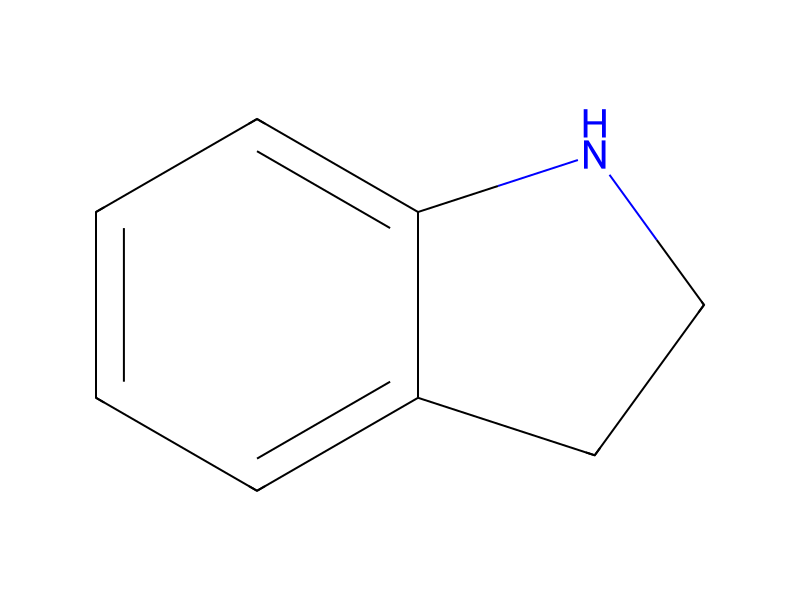

Product 1

Reagents, catalysts & solvents 1

Procedure
Part A: Indoline (2.2 g, 18.04 mmol), dissolved in dichloromethane (160 mL) was stirred with pyridinium tribromide (12 g, 37.6 mmol) for 16 h at 25° C. The reaction was quenched with sat NaHSO3 (50 mL) and water (50 mL). The dichloromethane was separated, dried (MgSO4) and stripped in vacuo. The residue was chromatographed on silica gel using 20% ethyl acetate/hexanes as eluent to give 5,7-dibromoindoline (4.2 g, 84% yield). 1H NMR(CDCl3) δ 7.28 (m, 1H), 7.11 (s, 1H), 3.96 (s br, 1H), 3.63 (t J=9 Hz, 1H), 3.13 (t J=9 Hz, 2H).
Workup
- customThe reaction was quenched with sat NaHSO3 (50 mL) and water (50 mL)
- customThe dichloromethane was separated
- dry with materialdried (MgSO4)
- customThe residue was chromatographed on silica gel using 20% ethyl acetate/hexanes as eluent
Sources & evidence
- ORD record
- ord-b527316b9a1245d59c6fab5d492dd61e
- Source dataset
- uspto-grants-2008_01
- Patent number
- US07319100B2
Reaction notes
Loading…