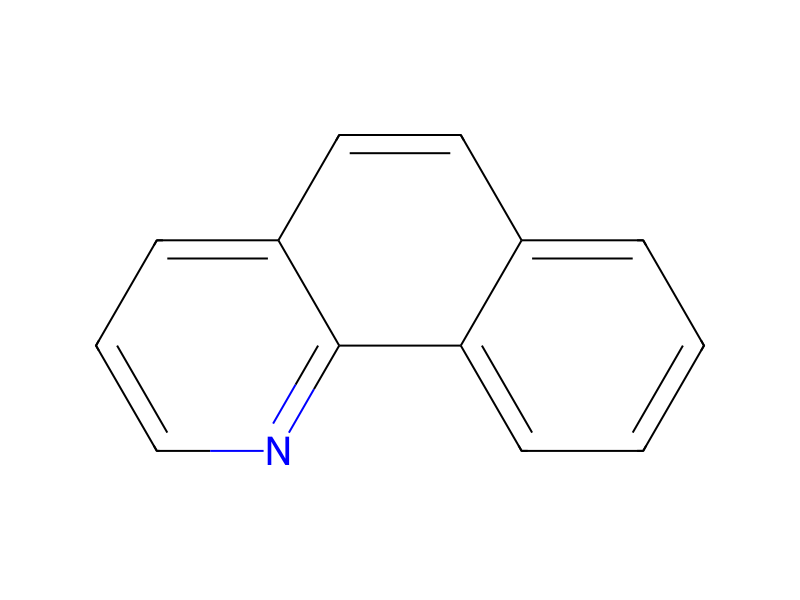
Potassium Hydroxide → Benzo(h)quinoline
Reaction equation

[NH2:1][C:2]1[C:11]2[C:6](=[CH:7][CH:8]=[CH:9][CH:10]=2)[CH:5]=[CH:4][C:3]=1[CH:12]=O.[OH-].[K+].O1CCO[CH2:18][CH2:17]1>>[N:1]1[C:2]2[C:3](=[CH:4][CH:5]=[C:6]3[CH:7]=[CH:8][CH:9]=[CH:10][C:11]3=2)[CH:12]=[CH:18][CH:17]=1Participants



Procedure
23.8 g of 2-bromobiphenyl was converted to the Grignard form in THF using 3.4 g of metal magnesium, then this reacted with 18.0 g of 9-fluorenone at from room temperature to 50° C. and, by treatment in the normal way, 9-(2-biphenyl)-9-fluorenol was obtained. This was heated in acetic acid to which a small amount of hydrochloric acid had been added, so that water was eliminated and, by treatment in the usual way, 9,9′-spirobifluorene (18.5 g) was obtained. Next, Connecting Unit 1 (15.8 g) was reacted with 8.6 g of acetyl chloride and 14.7 g of aluminium chloride at 50° C. in 1,2-dichloroethane and, by treatment in the normal way, 2,2′-diacetyl-9,9′-spirobifluorene (11.2 g) was obtained. This diacetyl compound (2.3 g) was reacted with 2.0 g of 1-amino-2-naphthalenecarbaldehyde and 1.6 g of potassium hydroxide at 60° C. in dioxane and, by treatment in the normal way, there was obtained BQ-1 (1.5 g) shown below. 1H-NMR (CDCl3, ppm): 9.4 (d, 2H), 8.6 (d.d, 2H), 8.1 (d, 2H), 8.0 (t, 4H), 7.8 (d, 2H), 7.8-7.6 (m, 12H), 7.4 (t, 2H), 7.2 (t, 2H), 6.8 (d, 2H).
Workup
- customthere was obtained BQ-1 (1.5 g)
Sources & evidence
- ORD record
- ord-7ee2b346de3b464d9799fdcf06503a39
- Source dataset
- uspto-grants-2008_01
- Patent number
- US07318966B2
Reaction notes
Loading…