Hydrochloric Acid → 2-Phenylpiperidine
Reaction equation

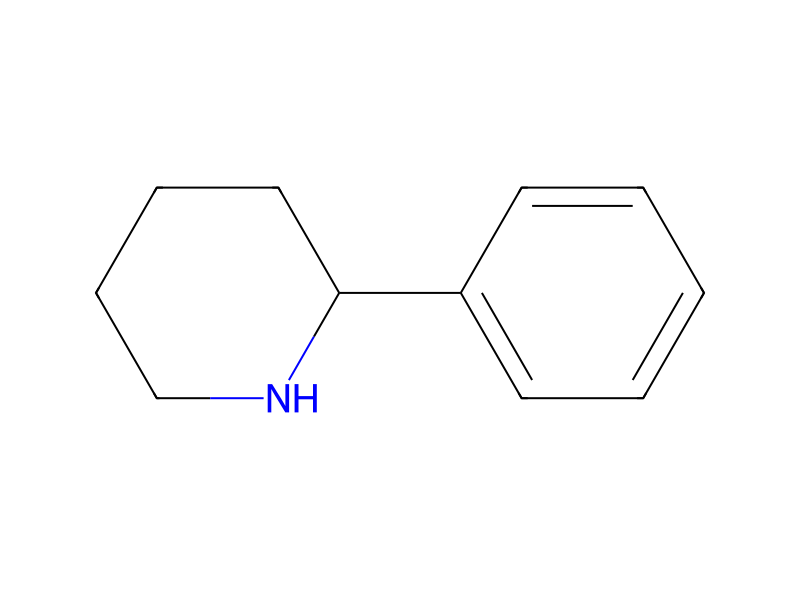
[C:1]1([C:7]2[CH:12]=[CH:11][CH:10]=[CH:9][N:8]=2)[CH:6]=[CH:5][CH:4]=[CH:3][CH:2]=1.Cl.[OH-].[Na+]>CCO.[Pt]=O>[C:1]1([CH:7]2[CH2:12][CH2:11][CH2:10][CH2:9][NH:8]2)[CH:6]=[CH:5][CH:4]=[CH:3][CH:2]=1Participants
6
Reactant 3



Product 1
Reagents, catalysts & solvents 2


Procedure
2-Phenylpyridine, Intermediate 14, (4.0 g, 25.81 mmol), and concentrated HCl (3 mL) in EtOH (15 mL) were treated with platinum oxide and subjected to catalytic hydrogenation (˜1 atm, balloon), at room temperature for 72 hours. After removal of the catalyst by filtration, the solution was evaporated in vacuo to a pale yellow HCl salt of the product. The free base is obtained by treating the residue with 10% aqueous sodium hydroxide. The aqueous is then extracted with Et2O several times and the extracts dried (MgSO4) and evaporated to an oil to give the title compound.
Workup
- customAfter removal of the catalyst
- filtrationby filtration
- customthe solution was evaporated in vacuo to a pale yellow HCl salt of the product
- customThe free base is obtained
- extractionThe aqueous is then extracted with Et2O several times
- dry with materialthe extracts dried (MgSO4)
- customevaporated to an oil
Sources & evidence
- ORD record
- ord-ab38fd919bbe41b688208f54298c7a37
- Source dataset
- uspto-grants-2008_01
- Patent number
- US07323464B2
Reaction notes
Loading…