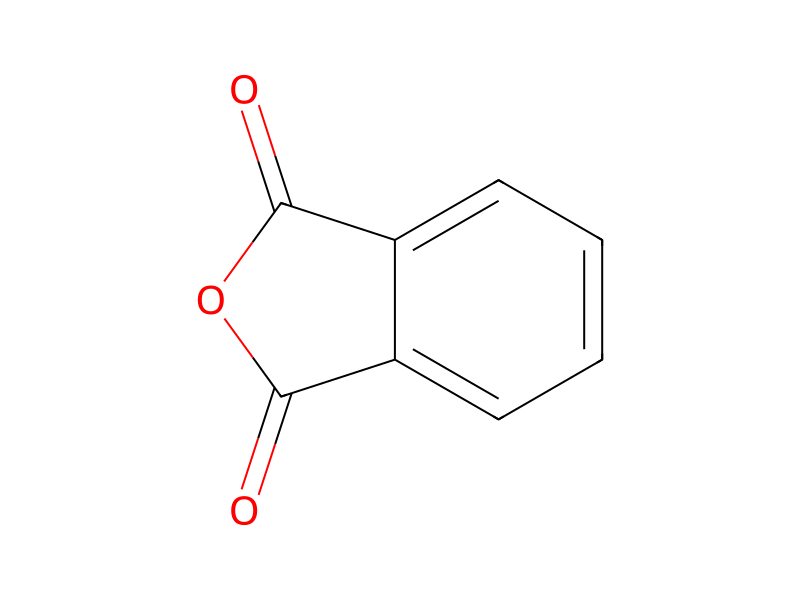
Benzene → Phthalic Anhydride
Reaction equation

C(O)(=O)C1C(=CC=CC=1)O.C1C=CC=CC=1.[C:17]([OH:28])(=[O:27])[C:18]1[C:19](=[CH:23][CH:24]=[CH:25][CH:26]=1)[C:20]([OH:22])=O>NC1C=CC=CC=1.[Cu]>[C:20]1(=[O:22])[O:28][C:17](=[O:27])[C:18]2=[CH:26][CH:25]=[CH:24][CH:23]=[C:19]12Participants
Reactant 3


Product 1
Reagents, catalysts & solvents 2


Procedure
Decarboxylation is not always a predictable reaction. For example, A. S. Sultanov, J. Gen. Chem. (USSR) 16 1835 (1946) as abstracted in CA 41:6223(e) discloses that salicylic acid may be decarboxylated by autoclaving the acid in the presence of copper bronze and benzene at 170° C. The acid alone decarboxylates at 205° C., while in the presence of aniline decarboxylation begins at 170° C. In the case of salicylic acid, aniline and copper bronze seem to be equal in catalytic ability. On the other hand, when phthalic acid is heated in aniline at 180° C., decarboxylation does not occur and instead phthalic anhydride is produced. Heating phthalic anhydride with copper bronze in chloroform at 180° C. gave a 22% yield of benzoic acid. Phthalic acid was found to decarboxylate to yield benzoic acid merely by heating in water at 235° C.
Workup
- customa predictable reaction
- customat 170° C
- custombegins at 170° C
Sources & evidence
- ORD record
- ord-ea128d8c5d9c4f04b4d3a4c1ff571b3e
- Source dataset
- uspto-grants-1993_08
- Patent number
- US05233085
Reaction notes
Loading…