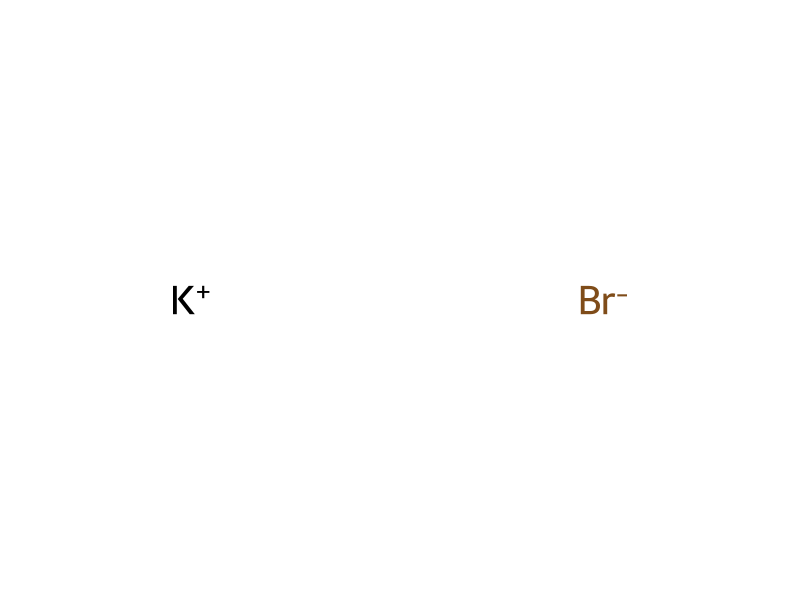
Potassium Bromide → 2-Amino-5-methylbenzamide
Reaction equation

[K+].[Br-].[CH3:3][C:4]1[CH:5]=[CH:6][C:7]([N+:13]([O-])=O)=[C:8]([CH:12]=1)[C:9]([NH2:11])=[O:10]>CO.[Pd]>[NH2:13][C:7]1[CH:6]=[CH:5][C:4]([CH3:3])=[CH:12][C:8]=1[C:9]([NH2:11])=[O:10]Participants
Reactant 2

Product 1

Reagents, catalysts & solvents 2


Procedure
A mixture of 5-methyl-2-nitrobenzoic acid (12) (36.2 g, 0.2 mol) and SOCl2 (50 mL) was heated under reflux for 20 min, during which a homogeneous solution was obtained. After removal of the excess SOCl2 with the aid of a water aspirator, the residue was dissolved in dry THF (40 mL) and the solution added dropwise with stirring to an ice-cold solution of NaOH (8 g, 0.2 mol) in 28% NH4OH (300 mL). The precipitate was collected, washed with water, and recrystallized from EtOH-H2O to obtain 5-methyl-2-nitrobenzamide (13) (31.5 g, 87%) as a white solid; mp 176°-177° C. [lit. (Findeklee, Ber. 38:3558, 1905) mp 176°-177° C.]; IR (KBr) V 1655 Cm-1 (amide C=O). A solution of 13 (31.5 g, 0.175 mol) in MeOH (250 mL) was shaken With 5% Pd-C (0.5 g) under 3 atm. of H2 for 24 h in a Parr apparatus. A solid formed after the initial heat of reaction subsided. The mixture was heated to boiling to redissolve the product, and was filtered while hot. The filtrate was evaporated under reduced pressure and the residue dried at 90° C. for 1 h (caution: some sublimation may occur) to obtain 2-amino-5-methylbenzamide (14) as a white solid (25.3 g, 96%); mp 173°-175° C. [lit. (Findeklee) mp 179° C.]; 1H-NMR (CDCl3) δ6.60 (d, 1H, J=8 Hz, C3 -H). To an ice-cold suspension of 14 (25.3 g, 0.168 mol) in 3.6N HCl (260 mL) was added dropwise over 25 min a solution of NaNO2 (12.75 g) in H2O (100 mL) while keeping the internal temperature below 5° C. After another 20 min of stirring at this temperature, 10N NaOH (100 mL) was added, causing all the solid to dissolve. The solution was acidified to pH 2 with 12N HCl and chilled. The solid was filtered and recrystallized from EtOH to obtain off-white needles (26.2 g, 97%); mp 217°-218° C. (dec, gas evolution) [lit. (Ferrand et al., Eur. J. Med. Chem. 2:337, 1987) mp 219°-220° C.]; IR (KBr) v 1680 (lactam C=O); 1H--NMR (d6 --DMSO+D2O) δ3.30 (s, 3H, 6--Me), 8.00 (m, 3H, aryl); UV (95% EtOH) λmax 208, 225, 282 nm.
Workup
- customA solid formed after the
- temperatureinitial heat of reaction
- temperatureThe mixture was heated
- dissolutionto redissolve the product
- filtrationwas filtered while hot
- customThe filtrate was evaporated under reduced pressure
- customthe residue dried at 90° C. for 1 h (caution
Sources & evidence
- ORD record
- ord-3c44deb98ca74a2eb04d5ff6b8b67073
- Source dataset
- uspto-grants-1993_08
- Patent number
- US05234925
Reaction notes
Loading…