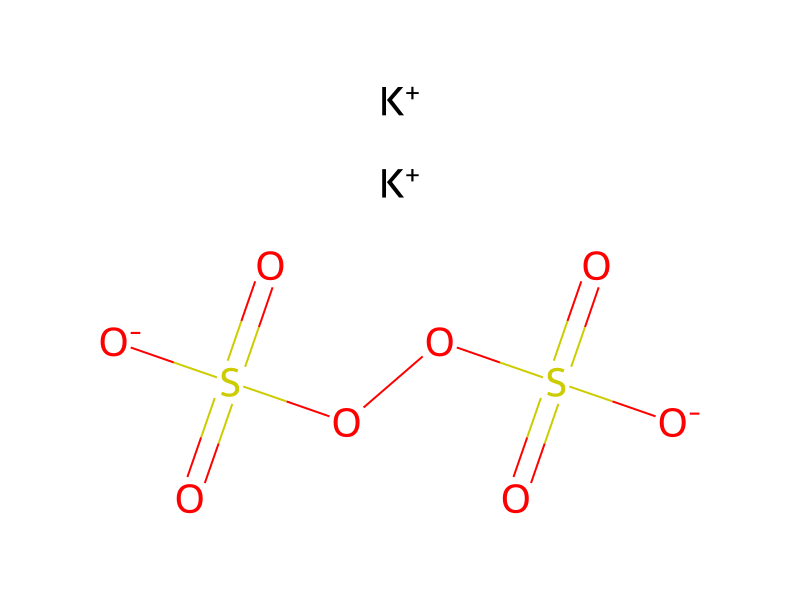
Potassium Persulfate → HCID 18964312, compound
Reaction equation

C(C1C=CC(O[CH:9]([C:21](=[O:26])[C:22]([CH3:25])([CH3:24])[CH3:23])[C:10]([NH:12][C:13]2[CH:18]=[CH:17][C:16]([Cl:19])=[CH:15][C:14]=2[Cl:20])=[O:11])=CC=1)(O)=O.Cl.[CH2:30]([N:32]([CH2:40][CH3:41])[C:33]1[CH:38]=[CH:37][C:36]([NH2:39])=[CH:35][CH:34]=1)[CH3:31].S(OOS([O-])(=O)=O)([O-])(=O)=O.[K+].[K+]>[OH-].[Na+].C(O)C.O>[CH3:25][C:22]([CH3:23])([CH3:24])[C:21](=[O:26])[C:9](=[N:39][C:36]1[CH:35]=[CH:34][C:33]([N:32]([CH2:40][CH3:41])[CH2:30][CH3:31])=[CH:38][CH:37]=1)[C:10]([NH:12][C:13]1[CH:18]=[CH:17][C:16]([Cl:19])=[CH:15][C:14]=1[Cl:20])=[O:11]Participants
Reactant 3


Product 1

Reagents, catalysts & solvents 3



Procedure
N-[4,4-dimethyl-2-[4-diethylaminophenyl]imino-3-oxopentanoyl]-2,4-dichloroaniline was prepared using a method analogous to that described in J. Korinek, J. Poskocil and J. Arient, Collection Czechoslov. Chem. Commun., 1979, 44, 1460. A solution of N-[2-[4-carboxyphenoxy]-4,4-dimethyl-3-oxopentanoyl]-2,4-dichloroaniline (10.0 g, 23.6 mmol, available from Eastman Kodak, Rochester, N.Y.) in a mixture of 1M aqueous sodium hydroxide solution (100 mL) and ethanol (50 mL), together with a solution of N,N-diethyl-p-phenylenediamine hydrochloride (5.20 g, 26 mmol) in ethanol (50 mL), was mixed all at once with a solution of potassium persulfate (7.0 g, 26 mmol) in water (250 mL) containing ethanol (50 mL). The yellow reaction mixture was stirred for one hour, and then extracted with dichloromethane (200 mL). The organic layer was separated and washed with a 50% saturated aqueous sodium chloride solution (200 mL) and dried over sodium sulfate. Evaporation of the solvent gave 11.4 g of crude material, which was taken up in dichloromethane (200 mL) and slurried with silica gel (40 g). After filtering, the solvent was removed to afford an oil (12 g) which was crystallized from hexanes (80 mL) to yield N-[4,4-dimethyl-2-[4-diethylaminophenyl]imino-3-oxopentanoyl]-2,4-dichloroaniline as an orange solid (7.1 g, 68% yield). The compound exhibited a maximum absorption in the visible region of the electromagnetic spectrum at 440 nm, ε=20,600. The structure of this compound was further confirmed by mass spectroscopy and by 1H and 13C NMR spectroscopy.
Workup
- customArient, Collection Czechoslov
- extractionextracted with dichloromethane (200 mL)
- customThe organic layer was separated
- washwashed with a 50% saturated aqueous sodium chloride solution (200 mL)
- dry with materialdried over sodium sulfate
- customEvaporation of the solvent
- customgave 11.4 g of crude material, which
Sources & evidence
- ORD record
- ord-ae9dacf25b9141fe835e3c9a9207ba2b
- Source dataset
- uspto-grants-1993_08
- Patent number
- US05236884
Reaction notes
Loading…