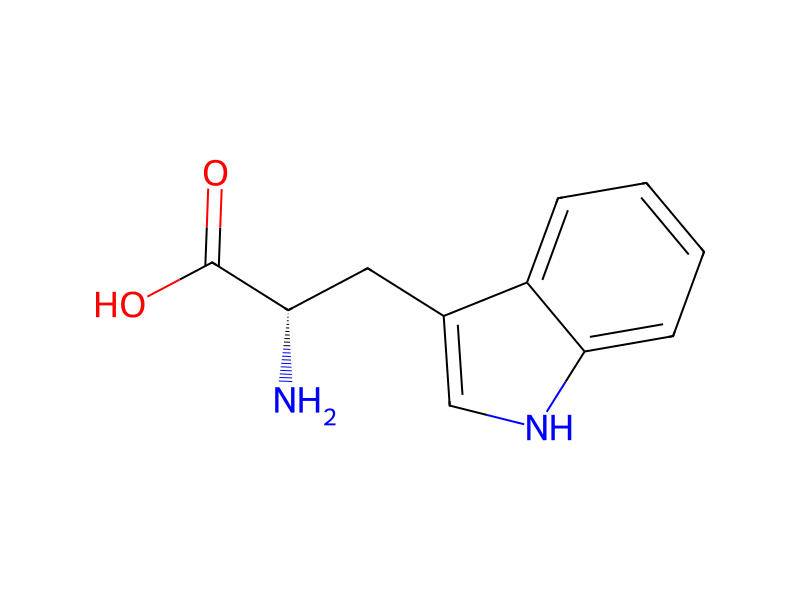
L-Tryptophan → HCID 19003114, compound
Reaction equation

[NH2:1][C@H:2]([C:13]([OH:15])=[O:14])[CH2:3][C:4]1[C:12]2[C:7](=[CH:8][CH:9]=[CH:10][CH:11]=2)[NH:6][CH:5]=1.[C:16](Cl)(=[O:23])[C:17]1[CH:22]=[CH:21][CH:20]=[CH:19][CH:18]=1.C(=O)([O-])[O-].[Cs+].[Cs+].[F:31][C:32]([F:42])([F:41])[C:33]1[CH:40]=[CH:39][CH:38]=[CH:37][C:34]=1[CH2:35]Br>C(=O)([O-])[O-].[Na+].[Na+].O1CCOCC1.CO.CN(C)C=O.O>[NH:6]1[C:7]2[C:12](=[CH:11][CH:10]=[CH:9][CH:8]=2)[C:4]([CH2:3][CH:2]([NH:1][C:16](=[O:23])[C:17]2[CH:22]=[CH:21][CH:20]=[CH:19][CH:18]=2)[C:13]([O:15][CH2:35][C:34]2[CH:37]=[CH:38][CH:39]=[CH:40][C:33]=2[C:32]([F:31])([F:41])[F:42])=[O:14])=[CH:5]1Participants
Reactant 4



Product 1

Reagents, catalysts & solvents 5





Procedure
To a suspension of L-Tryptophan (5.1 g) in saturated aqueous sodium carbonate solution (100 ml) was added a solution of benzoyl chloride (5 g) in dioxane (100 ml) over a period of 1 hour. The reaction mixture was then stirred for a further 2 hours. Water (100 ml) was then added to the reaction mixture and unwanted organics were extracted into ethyl acetate (5×100 ml). Hydrochloric acid (5N) was then added to the aqueous layer and the free acid was extracted into ethyl acetate (250 ml), dried (MgSO4) and solvent was removed in vacuo to afford a pale brown solid. A portion of this solid (0.5 g) was added to a solution of caesium carbonate (0.26 g) in methanol (20 ml). Once a clear solution was obtained, the solvent was removed in vacuo to leave a white solid. Dimethylformamide (20 ml) was added to the residue, then 2-trifluoromethylbenzylbromide (0.17 g) was added and the reaction was stirred for 16 hours at ambient temperature. The solvent was removed in vacuo, the residue was dissolved in dichloromethane (100 ml) and washed with water (2×50 ml), and dried (MgSO4). The solvent was removed in vacuo to afford a white solid. The product was purified by recrystallisation from ethyl acetate/petroleum ether to give the title compound (0.58 g), m.p. 117° C. 1H NMR (360 MHz, CDCl3) δ8.06 (1H, s), 7.66 (2H, d, J=7.2 Hz), 7.57-7.33 (9H, m), 7.16 (1H, t, J=7.2 Hz), 7.06 (1H, t, J=7.2 Hz), 6.92 (1H, d, J=2.1 Hz), 6.66 (1H, d, J=7.2 Hz), 5.35 (1H, d, J=14.4 Hz), 5.30 (1H, d, J=14.4 Hz), 5.22 (1H, m), 3.46 (2H, d, J=7.2 Hz).
Workup
- extractionunwanted organics were extracted into ethyl acetate (5×100 ml)
- additionHydrochloric acid (5N) was then added to the aqueous layer
- extractionthe free acid was extracted into ethyl acetate (250 ml)
- dry with materialdried (MgSO4) and solvent
- customwas removed in vacuo
- customto afford a pale brown solid
- customOnce a clear solution was obtained
- customthe solvent was removed in vacuo
- customto leave a white solid
- stirringthe reaction was stirred for 16 hours at ambient temperature
- customThe solvent was removed in vacuo
- dissolutionthe residue was dissolved in dichloromethane (100 ml)
- washwashed with water (2×50 ml)
- dry with materialdried (MgSO4)
- customThe solvent was removed in vacuo
- customto afford a white solid
- customThe product was purified by recrystallisation from ethyl acetate/petroleum ether
Sources & evidence
- ORD record
- ord-98be8a31cad745078eeb04ce5d34d25a
- Source dataset
- uspto-grants-1995_12
- Patent number
- US05472978
Reaction notes
Loading…