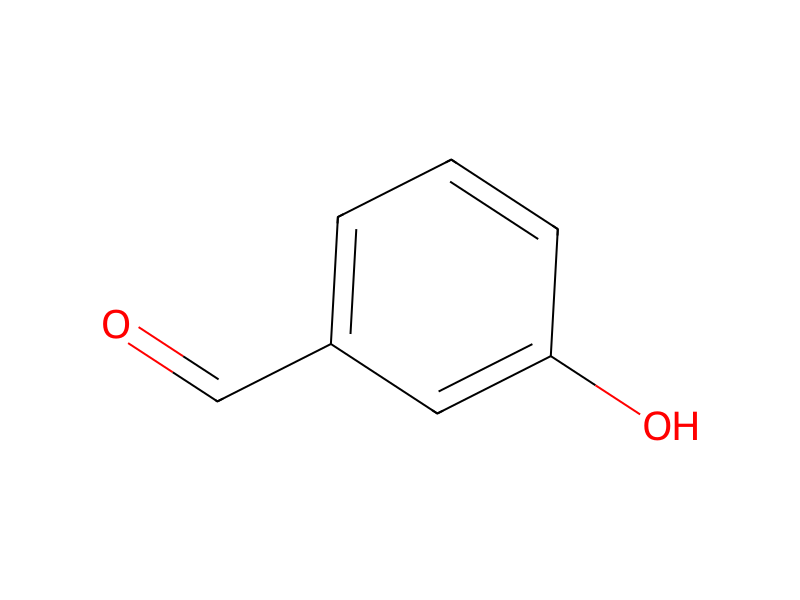
3-Hydroxybenzaldehyde → HCID 19422232, compound
Reaction equation

[OH:1][C:2]1[CH:3]=[C:4]([CH:7]=[CH:8][CH:9]=1)[CH:5]=[O:6].CC(C)([O-])C.[K+].Br[CH:17]([C:19]1[CH:24]=[CH:23][CH:22]=[CH:21][CH:20]=1)[CH3:18]>CS(C)=O.[Cl-].[Na+].O>[C:19]1([CH:17]([O:1][C:2]2[CH:3]=[C:4]([CH:7]=[CH:8][CH:9]=2)[CH:5]=[O:6])[CH3:18])[CH:24]=[CH:23][CH:22]=[CH:21][CH:20]=1Participants
6





Procedure
To a solution of 3-hydroxybenzaldehyde (5.28 g, 43.2 mmol) in DMSO (80 mls) was added potassium t-butoxide (5.58 g, 49.7 mmol) and the mixture was stirred for 20 mins. (1-Bromoethyl)benzene (10.00 g, 54 mmol) was then added dropwise and the reaction was stirred for 18 hrs. It was then diluted with brine (250 mls) and extracted with ethylacetate (3×250 mls). The organics were combined, dried with MgSO4 and concentrated. The resulting residue was chromatographed (silica gel, hexanes:ether, 92.5:7.5) to afford 5.88 g (60%) of 3-(1-phenylethoxy)benzaldehyde as a pale yellow oil.
Workup
- stirringthe reaction was stirred for 18 hrs
- extractionextracted with ethylacetate (3×250 mls)
- dry with materialdried with MgSO4
- concentrationconcentrated
- customThe resulting residue was chromatographed (silica gel, hexanes:ether, 92.5:7.5)
Sources & evidence
- ORD record
- ord-5d297c614fd746908810bb9bc069d956
- Source dataset
- uspto-grants-1995_12
- Patent number
- US05476873
Reaction notes
Loading…