Benzaldehyde → 5-Benzyl-1,3-thiazolidine-2,4-dione
Reaction equation

C(=O)C1C=CC=CC=1.S1CC(=O)NC1=O.[CH:16](=[C:23]1[S:27][C:26](=[O:28])[NH:25][C:24]1=[O:29])[C:17]1[CH:22]=[CH:21][CH:20]=[CH:19][CH:18]=1>O1CCOCC1.[Pd]>[CH2:16]([CH:23]1[S:27][C:26](=[O:28])[NH:25][C:24]1=[O:29])[C:17]1[CH:18]=[CH:19][CH:20]=[CH:21][CH:22]=1Participants
6
Reactant 3

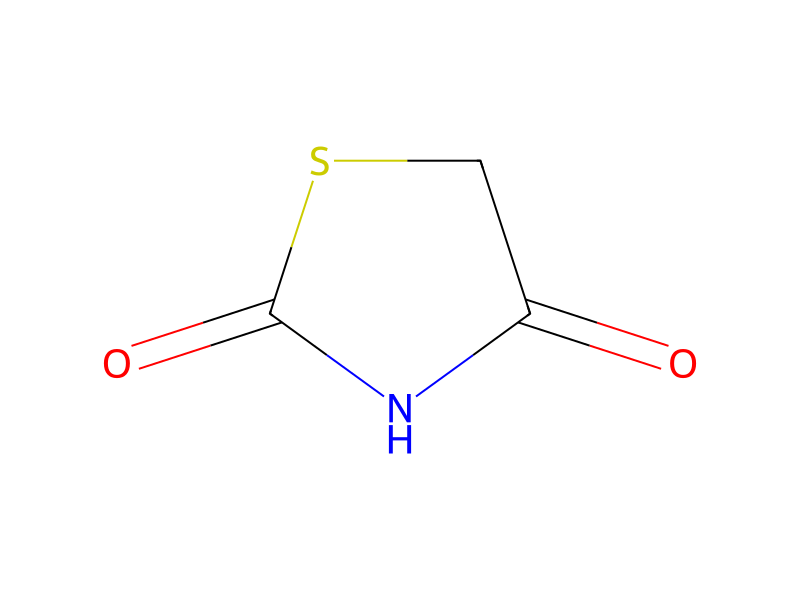

Product 1

Reagents, catalysts & solvents 2


Procedure
Benzaldehyde (10.6 g) and 2,4-thiazolidinedione (11.7 g) were reacted together by a procedure analogous to that described in Example 1. The resulting material, 5-benzylidene-2,4-thiazolidinedione (18.5 g) was dissolved in dioxan (300 ml) and hydrogenated over 10% Palladium-charcoal (18.5 g) at 200 psi, overnight. The mixture was filtered through diatomaceous earth, the filter cake thoroughly washed with dioxan, and the combined dioxan solutions evaporated to afford the title compound, mp 83°-86° C.
Workup
- filtrationThe mixture was filtered through diatomaceous earth
- washthe filter cake thoroughly washed with dioxan
- customthe combined dioxan solutions evaporated
Sources & evidence
- ORD record
- ord-ae1aed16bebd4500981826bbe449e6f2
- Source dataset
- uspto-grants-1995_12
- Patent number
- US05478850
Reaction notes
Loading…