Pyridine → 2,2,2-Trichloroethyl [4-(1H-pyrazol-1-yl)phenyl]carbamate
Reaction equation
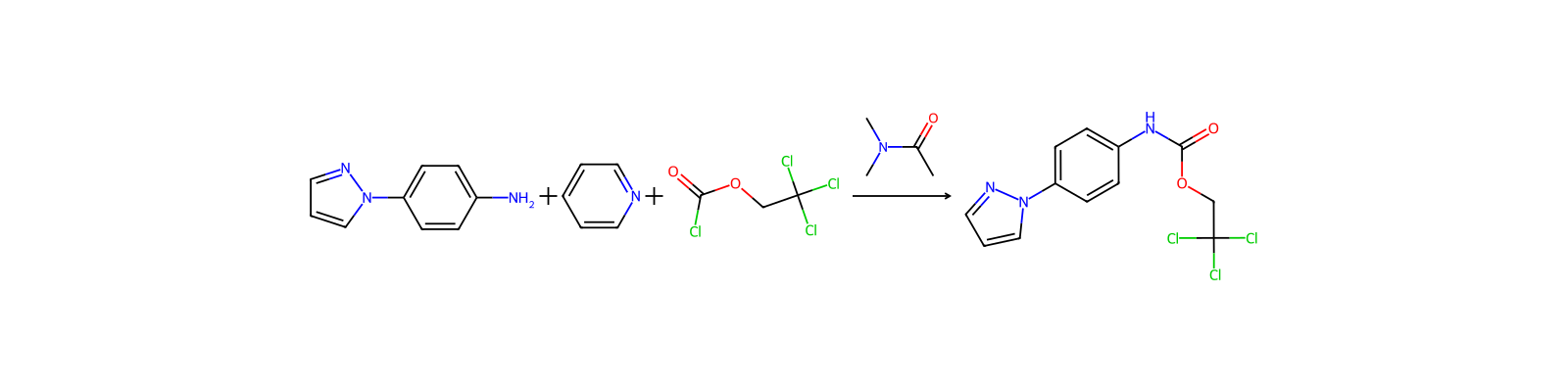
[N:1]1([C:6]2[CH:12]=[CH:11][C:9]([NH2:10])=[CH:8][CH:7]=2)[CH:5]=[CH:4][CH:3]=[N:2]1.N1C=CC=CC=1.Cl[C:20]([O:22][CH2:23][C:24]([Cl:27])([Cl:26])[Cl:25])=[O:21]>CN(C)C(=O)C>[N:1]1([C:6]2[CH:7]=[CH:8][C:9]([NH:10][C:20](=[O:21])[O:22][CH2:23][C:24]([Cl:27])([Cl:26])[Cl:25])=[CH:11][CH:12]=2)[CH:5]=[CH:4][CH:3]=[N:2]1Participants
5



Procedure
To a solution of 4-(1H-pyrazol-1-yl)aniline (1.00 g, 6.28 mmol) and pyridine (1.52 ml, 18.8 mmol) in N,N-dimethylacetamide (20 ml) was added 2,2,2-trichloroethyl chloroformate (1.30 ml, 9.42 mmol) under ice-cooling, and the mixture was stirred under ice-cooling for 2 hours. The reaction mixture was poured into ice-water, and 2.00 g (95.2%) of the desired product was collected by filtration as a solid.
Workup
- temperaturecooling
- temperaturecooling for 2 hours
Sources & evidence
- ORD record
- ord-c04c78fd1ad749cf96f7bb26cc05e57e
- Source dataset
- uspto-grants-2010_12
- Patent number
- US07851473B2
Reaction notes
Loading…