Sulfuric Acid → 1,4:3,6-Dianhydro-D-mannitol
Reaction equation

O[CH2:2][C@@H:3]([C@H:5]([C@@H:7]([C@@H:9]([CH2:11][OH:12])[OH:10])[OH:8])O)[OH:4].S(=O)(=O)(O)O.[CH2:18]1[O:22][CH:21]([CH:23]([OH:26])[CH2:24]O)[C@@H:20]([OH:27])[CH:19]1[OH:28].C1O[C@@H]2[C@@H](O)CO[C@@H]2[C@@H]1O>>[CH2:11]1[O:12][C@@H:5]2[C@H:3]([OH:4])[CH2:2][O:8][C@@H:7]2[C@@H:9]1[OH:10].[CH2:24]1[O:27][C@@H:20]2[C@@H:19]([OH:28])[CH2:18][O:22][C@@H:21]2[C@H:23]1[OH:26]Participants

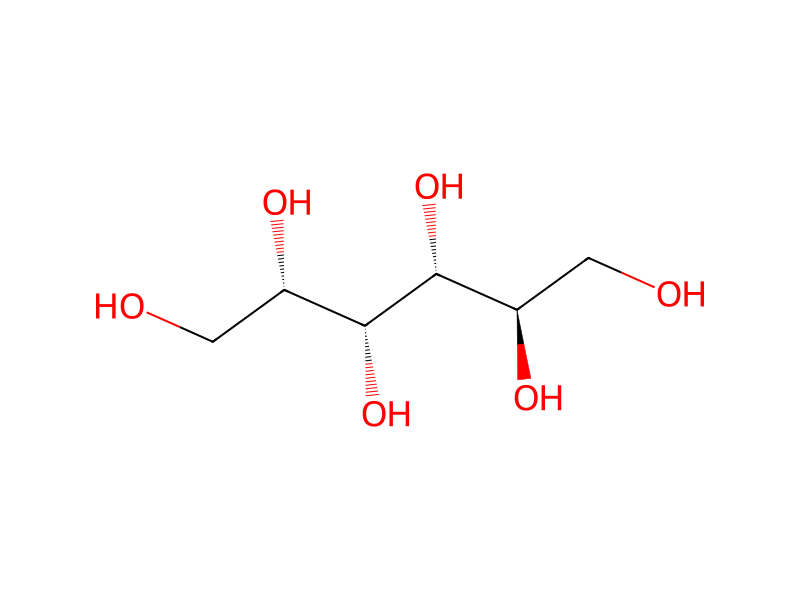


Conditions
- Temperature
- 125 °C
Procedure
A reaction was carried out wherein sorbitol and sulfuric acid (0.5% by weight of the starting sorbitol) were combined in a reaction vessel. The vessel was heated to 125° C. and run under a vacuum of about 10-20 millibar. Samples of the reaction mixture were taken at regular intervals and assayed for sorbitol, sorbitan, mannitan, and isosorbide. The results are shown in FIG. 1. The sorbitol concentration decreases smoothly as a function of time to approximately zero after about 120 minutes (the sorbitol line is believed to include also mannitol and iditol which, in turn, react to give isomannide or isoidide). The concentration of sorbitan increases and then decreases as it is first condensed from sorbitol and then converted to isosorbide. Isosorbide is formed at a reasonable rate only after significant amounts of sorbitan have been produced. As the sorbitan is consumed, isosorbide becomes the major compound in the reaction mixture. The reaction mixture also contains small amounts of mannitan and iditan.
Workup
- customwere combined in a reaction vessel
- concentrationThe sorbitol concentration
- customin turn, react
Sources & evidence
- ORD record
- ord-4a8abb47542e4da1854ee850bb4f12ea
- Source dataset
- uspto-grants-2015_09
- Patent number
- US09120806B2
Reaction notes
Loading…