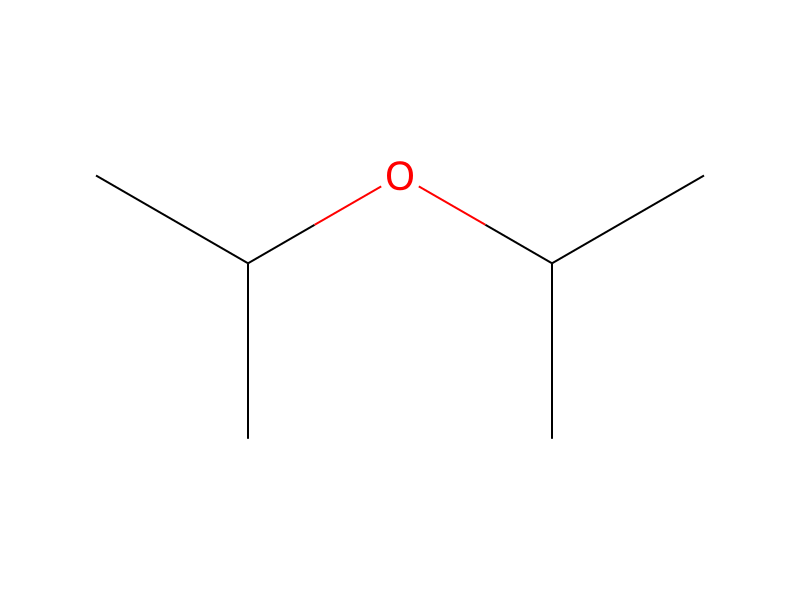
Diisopropyl Ether → 2-Methoxy-4-methylquinoline
Reaction equation

Br[CH2:2][C:3]1[C:12]2[C:7](=[CH:8][CH:9]=[CH:10][CH:11]=2)[N:6]=[C:5]([O:13][CH3:14])[CH:4]=1.COC1C=CC2N=CC=C([C@@H](O)[C@H]3N4C[C@H](C=C)[C@@H](CC4)C3)C=2C=1.C(OC(C)C)(C)C>C(#N)C>[CH3:14][O:13][C:5]1[CH:4]=[C:3]([CH3:2])[C:12]2[C:7](=[CH:8][CH:9]=[CH:10][CH:11]=2)[N:6]=1Participants
Reactant 3


Product 1

Reagents, catalysts & solvents 1

Conditions
- Temperature
- 70 °C
Procedure
The 4-(bromomethyl)-2-methoxyquinoline obtained in Step 2 was dissolved in 7 mL of acetonitrile, and then 0.5 g (1.54 mmol) of quinine was added, and stirred for 2 hours while heated at 70° C. After stirring was completed, the solution was cooled to a normal temperature, and 20 mL of diisopropyl ether was added. Then, the solution was filtered under reduced pressure to separate a solid precipitated in the reaction solution. The resultant residual solid was washed with a mixed solvent of 5 mL of chloroform and 15 mL of diisopropyl ether. After washing, the solid was dried under reduced pressure to obtain 0.82 g of the target compound, 2-methoxy-4-methyl quinoline quininium bromide. The melting point was 181° C. to 191° C. (degradation). M+496 was confirmed by LCMS.
Workup
- stirringAfter stirring
- additionwas added
- filtrationThen, the solution was filtered under reduced pressure
- customto separate a solid
- customprecipitated in the reaction solution
- washThe resultant residual solid was washed with a mixed solvent of 5 mL of chloroform and 15 mL of diisopropyl ether
- washAfter washing
- customthe solid was dried under reduced pressure
Sources & evidence
- ORD record
- ord-a0e7f684d3fe4729a97e3b769d6011da
- Source dataset
- uspto-grants-2015_09
- Patent number
- US09126995B2
Reaction notes
Loading…