Methanesulfonic Acid → 2-Chloro-9,9-dimethyl-9,10-dihydroacridine
Reaction equation

[Cl:1][C:2]1[CH:7]=[CH:6][C:5]([NH:8][C:9]2[CH:14]=[CH:13][CH:12]=[CH:11][C:10]=2[C:15](O)([CH3:17])[CH3:16])=[CH:4][CH:3]=1.CS(O)(=O)=O>C1(C)C=CC=CC=1>[Cl:1][C:2]1[CH:7]=[CH:6][C:5]2[NH:8][C:9]3[C:10](=[CH:11][CH:12]=[CH:13][CH:14]=3)[C:15]([CH3:17])([CH3:16])[C:4]=2[CH:3]=1Participants
4
Reactant 2
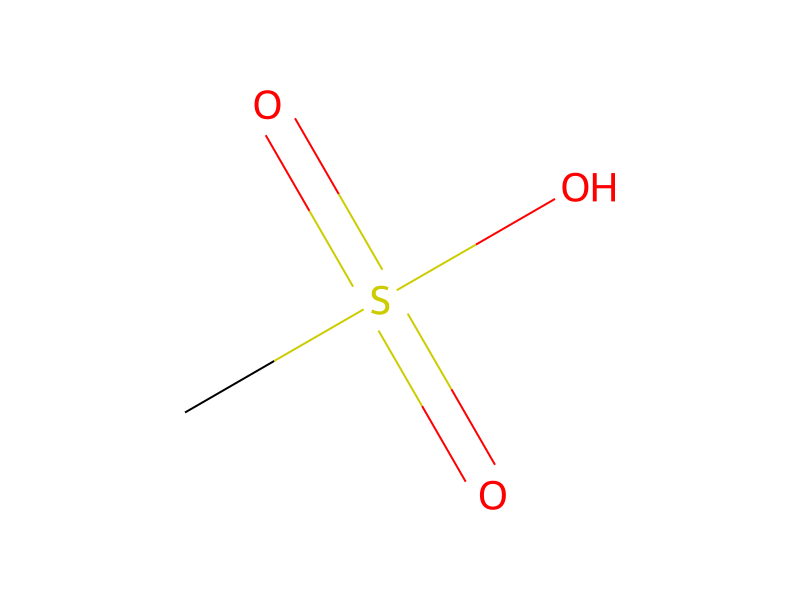

Product 1

Reagents, catalysts & solvents 1

Procedure
30.3 g (116 mmol) of 2-[2-(4-chlorophenylamino)phenyl]propan-2-ol are dissolved in 700 ml of degassed toluene, a suspension of 93 g of polyphosphoric acid and 61.7 g of methanesulfonic acid is added, and the mixture is stirred at room temperature for 1 h and heated at 50° C. for 1 h. The batch is cooled and poured onto ice and extracted three times with ethyl acetate. The combined organic phases are washed with saturated sodium chloride solution, dried over magnesium sulfate and evaporated. Filtration of the crude product through silica gel with heptane/ethyl acetate (20:1) gives 25.1 g (89%) of 2-chloro-9,9-dimethyl-9,10-dihydroacridine as pale-yellow crystals.
Workup
- additionis added
- temperatureheated at 50° C. for 1 h
- temperatureThe batch is cooled
- additionpoured onto ice
- extractionextracted three times with ethyl acetate
- washThe combined organic phases are washed with saturated sodium chloride solution
- dry with materialdried over magnesium sulfate
- customevaporated
- filtrationFiltration of the crude product through silica gel with heptane/ethyl acetate (20:1)
Sources & evidence
- ORD record
- ord-df910704b5c543998ff7051a02e98b41
- Source dataset
- uspto-grants-2015_09
- Patent number
- US09133119B2
Reaction notes
Loading…