Carbazole → 9-Decyl-9H-carbazole
Reaction equation

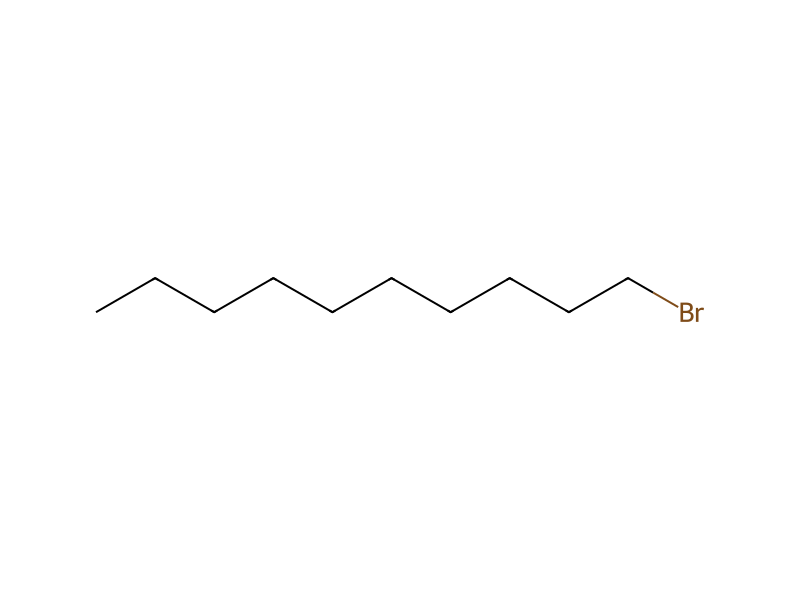
[CH:1]1[C:13]2[NH:12][C:11]3[C:6](=[CH:7][CH:8]=[CH:9][CH:10]=3)[C:5]=2[CH:4]=[CH:3][CH:2]=1.Br[CH2:15][CH2:16][CH2:17][CH2:18][CH2:19][CH2:20][CH2:21][CH2:22][CH2:23][CH3:24].[OH-].[Na+]>[Br+].C([N+](CCCC)(CCCC)CCCC)CCC.C1C=CC=CC=1>[CH2:15]([N:12]1[C:11]2[CH:10]=[CH:9][CH:8]=[CH:7][C:6]=2[C:5]2[C:13]1=[CH:1][CH:2]=[CH:3][CH:4]=2)[CH2:16][CH2:17][CH2:18][CH2:19][CH2:20][CH2:21][CH2:22][CH2:23][CH3:24]Participants
Reactant 3


Product 1

Reagents, catalysts & solvents 2


Conditions
- Temperature
- 80 °C
Procedure
To a solution of carbazole (2.1 g, 12.5 mmol), benzene (10 mL), tetrabutylammonium bromine (0.1 g, 0.7 mmol) and 1-bromodecane (3.0 mL, 15 mmol), was added 50% NaOH aqueous solution (15 mL). The solution mixture was heated to 80° C. and stirred for 2 h. The solvent was evaporated in vacuo and the residue was extracted with dichloromethane (3×30 mL). The organic layer was dried over anhydrous Na2SO4 and filtered. After removal of solvent, the product was purified by silica gel column chromatography using petroleum ether/dichloromethane as eluent affording 9-decylcarbazole as a colorless liquid (3.4 g, 90%). 1H NMR (400 MHz, CDCl3, δ) 8.10 (d, J=7.6 Hz, 2H), 7.48-7.38 (m, 4H), 7.24 (dd, J=14.4 Hz, J=1.2 Hz, 2H), 4.30 (t, J=7.2 Hz, 2H), 1.89-1.81 (m, 2H), 1.39-1.23 (m, 14H), 0.88 (t, J=7.0 Hz, 3H). 13C NMR (100 MHz, CDCl3, δ) 140.4, 125.5, 122.8, 120.3, 118.6, 108.6, 43.1, 31.8, 29.5, 29.48, 29.40, 29.3, 28.9, 27.3, 22.7, 14.1. MS (MALDI-TOF): m/z 307.2579 (M+).
Workup
- customThe solvent was evaporated in vacuo
- extractionthe residue was extracted with dichloromethane (3×30 mL)
- dry with materialThe organic layer was dried over anhydrous Na2SO4
- filtrationfiltered
- customAfter removal of solvent
- customthe product was purified by silica gel column chromatography
Sources & evidence
- ORD record
- ord-c980790e19bd4b7dba3d2df665551ca7
- Source dataset
- uspto-grants-2015_09
- Patent number
- US09147848B2
Reaction notes
Loading…