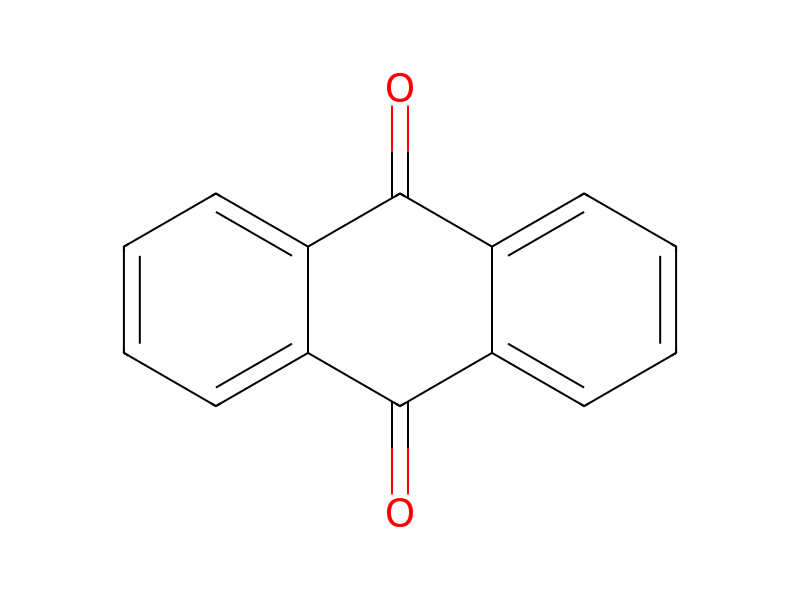
1,2-Diaminoanthraquinone → Anthraquinone
Reaction equation

N[C:2]1[CH:15]=[CH:14][C:13]2[C:12](=[O:16])[C:11]3[C:6](=[CH:7][CH:8]=[CH:9][CH:10]=3)[C:5](=[O:17])[C:4]=2[C:3]=1N.FC1N=C(F)N=C(SCCCC)N=1>>[CH:7]1[C:6]2[C:5](=[O:17])[C:4]3[C:13](=[CH:14][CH:15]=[CH:2][CH:3]=3)[C:12](=[O:16])[C:11]=2[CH:10]=[CH:9][CH:8]=1Participants


Procedure
Instead of using a unitary diaminoanthraquinone of the formula (2) it is also possible to use a mixture of diaminoanthraquinones, for example a mixture of 1,5-, 1,6- and 1,7-diaminoanthraquinone. Mixtures of the diaminoanthraquinones which are formed in the industrial manufacture of diaminoanthraquinones by dinitration of anthraquinone and subsequent reduction are particularly suitable. Such mixtures contain for example small amounts of 2,7- and 2,8-diaminoanthraquinone (β-isomers) and 1-aminoanthraquinone in addition to the 1,8-, 1,5-, 1,7- and 1,6-diaminoanthraquinones principally obtained, or they contain small amounts of 1-aminoanthraquinone, 2-aminoanthraquinone and 1-amino-2-, -4-, -5- and -8-hydroxyanthraquinone in addition to 1,6-, 1,8-, 1,7-, 2,6-, 2,7- and 1,5-diaminoanthraquinone.
Sources & evidence
- ORD record
- ord-62f0f3dfe5b149e2ac7c2db3d7173477
- Source dataset
- uspto-grants-1981_05
- Patent number
- US04265633
Reaction notes
Loading…