Acetic Acid → Xanthene
Reaction equation

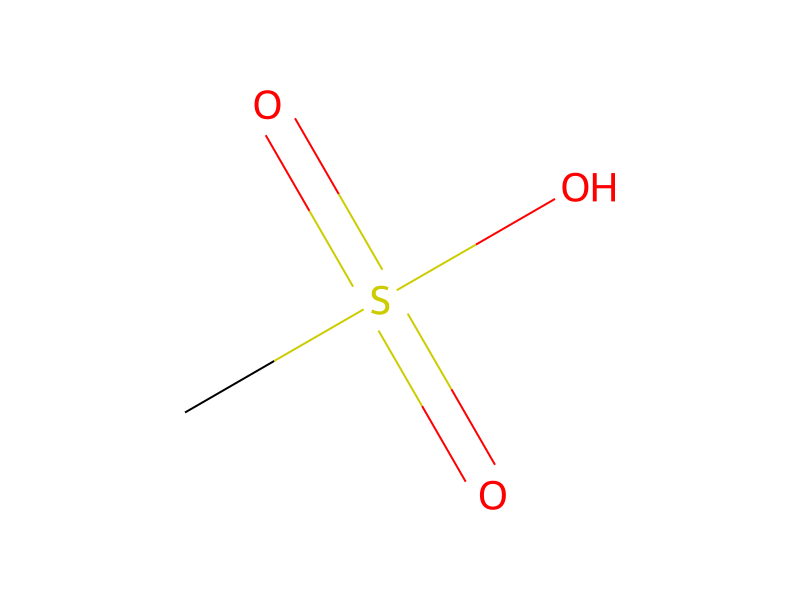
CS(O)(=O)=O.[C:6]1([CH3:16])[C:7](S(O)(=O)=O)=[CH:8][CH:9]=[CH:10][CH:11]=1.S(=O)(=O)(O)O.[C:22]([OH:25])(=O)[CH3:23]>>[CH:11]1[C:6]2[CH2:16][C:23]3[C:22](=[CH:7][CH:6]=[CH:11][CH:10]=3)[O:25][C:7]=2[CH:8]=[CH:9][CH:10]=1Participants




Procedure
The compounds according to the present invention can be synthesized by reference to the methods described in Journal of the American Chemical Society, Vol. 72, pages 3651 to 3655 or similar methods. A nuclear-substituted hydroquinone, as a starting material, is dissolved in a weak acidic carboxylic acid solvent such as acetic acid in an amount of about 10-2 mol/l to 5 mol/l and, a strong acidic compound such as hydrochloric acid is added to the solution in an amount of about 0.1 to 5 times w/w (weight ratio) based on the starting material. A condensing agent such as formalin, acetone or aldehydes is added to the solution in an amount of about 0.5 to 5 moles based on the starting material and the resulting solution is stirred at about 10° to 100° C. to obtain a diarylmethane compound. The resulting diarylmethane compound is dissolved in a solvent such as a hydrocarbon solvent (for example, benzene, toluene), an alcohol solvent (for example, ethanol, propanol), or an organic acid (for example, acetic acid) and, the solution is heated with refluxing in the presence or non-presence of a strong acid (for example, methane sulfonic acid, toluene sulfonic acid, sulfuric acid) in an amount of about 0.1 to 1.0 mole based on the starting material to obtain an objective compound of a xanthene compound. Specific synthesis examples are illustrated below for reference.
Sources & evidence
- ORD record
- ord-c1026be5623245a9ab2e836a5f35611d
- Source dataset
- uspto-grants-1981_05
- Patent number
- US04266020
Reaction notes
Loading…