Dicyclohexylcarbodiimide → N,N'-Dicyclohexylurea
Reaction equation

[CH:1]1([N:7]=[C:8]=[N:9][CH:10]2[CH2:15][CH2:14][CH2:13][CH2:12][CH2:11]2)[CH2:6][CH2:5][CH2:4][CH2:3][CH2:2]1.C(CC(O)=O)(=[O:18])N.C(C1CN1)#N>O1CCCC1>[C:8]([NH:7][CH:1]1[CH2:2][CH2:3][CH2:4][CH2:5][CH2:6]1)([NH:9][CH:10]1[CH2:15][CH2:14][CH2:13][CH2:12][CH2:11]1)=[O:18]Participants
5
Reactant 3



Product 1
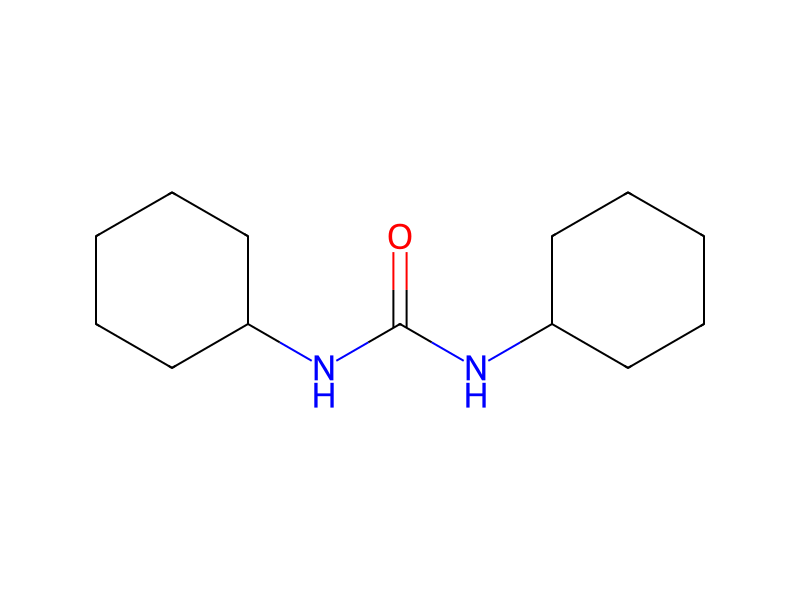
Reagents, catalysts & solvents 1

Conditions
- Temperature
- 0 °C
Procedure
2.15 g. Dicyclohexylcarbodiimide are introduced portionwise at 0° to 5° C. into a suspension of 1.03 g. carbamoylacetic acid and 0.68 g. 2-cyanoaziridine in 18 ml. tetrahydrofuran. The reaction mixture is stirred for 1 hour at 0° C. and then for 2 hours at ambient temperature. It is then filtered with suction and the solid material is washed with tetrahydrofuran and diethyl ether into the filtrate, 2.2 g. dicyclohexylurea (m.p. 226°-228° C.) being obtained. The filtrate is evaporated in a vacuum and the evaporation residue is triturated with ether to give 1.3 g. 1-carbamoylacetyl-2-cyanoaziridine; m.p. 115°-119° C.
Workup
- waitfor 2 hours at ambient temperature
- filtrationIt is then filtered with suction
- washthe solid material is washed with tetrahydrofuran and diethyl ether into the filtrate, 2.2 g
Sources & evidence
- ORD record
- ord-71adc97e9e564a7ca15bf66a3492acaa
- Source dataset
- uspto-grants-1981_05
- Patent number
- US04267174
Reaction notes
Loading…