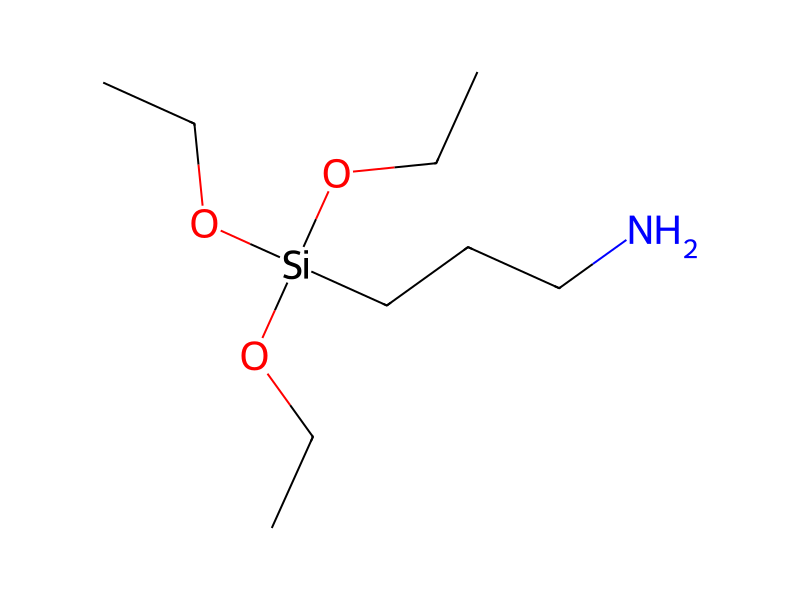
(3-Aminopropyl)triethoxysilane → HCID 15457203, compound
Reaction equation

[C:1]1([C:7]#[C:8][C:9]2[CH:10]=[C:11]3[C:16](=[O:17])[O:15][C:13](=O)[C:12]3=[CH:18][CH:19]=2)[CH:6]=[CH:5][CH:4]=[CH:3][CH:2]=1.[NH2:20][CH2:21][CH2:22][CH2:23][Si:24]([O:31][CH2:32][CH3:33])([O:28][CH2:29][CH3:30])[O:25][CH2:26][CH3:27]>C1COCC1>[C:1]1([C:7]#[C:8][C:9]2[CH:10]=[C:11]3[C:16](=[O:17])[N:20]([CH2:21][CH2:22][CH2:23][Si:24]([O:31][CH2:32][CH3:33])([O:25][CH2:26][CH3:27])[O:28][CH2:29][CH3:30])[C:13](=[O:15])[C:12]3=[CH:18][CH:19]=2)[CH:2]=[CH:3][CH:4]=[CH:5][CH:6]=1Participants
4
Reactant 2

Product 1

Reagents, catalysts & solvents 1

Procedure
4-phenylethynyl-N [3-triethoxysilylpropyl] phthalimide was synthesized as follows. 4-phenylethynyl phthalic anhydride (PEPA) was added to a round bottom flask containing sufficient tetrahydrafuran (THF) to dissolve the PEPA. An equimolar amount of 3-aminopropytriethoxy silane (3-APS) was added to the mixture at room temperature. The mixture was then heated over a steam bath until the THF mixture began to boil (T=65° C.). The heating continued for approximately 5 minutes. The solution was then removed from the steam bath and allowed to cool. The solvent was removed using a rotovaporator at 40° C. The resulting product is a thick, viscous, yellow (amber) liquid.
Workup
- custom(T=65° C.)
- customThe solution was then removed from the steam bath
- temperatureto cool
- customThe solvent was removed
- customat 40° C
Sources & evidence
- ORD record
- ord-436864bf1510402bb06df49daaf58d24
- Source dataset
- uspto-grants-2000_07
- Patent number
- US06084106
Reaction notes
Loading…