Trichloroacetyl chloride → 2-(Trichloroacetyl)pyrrole
Reaction equation

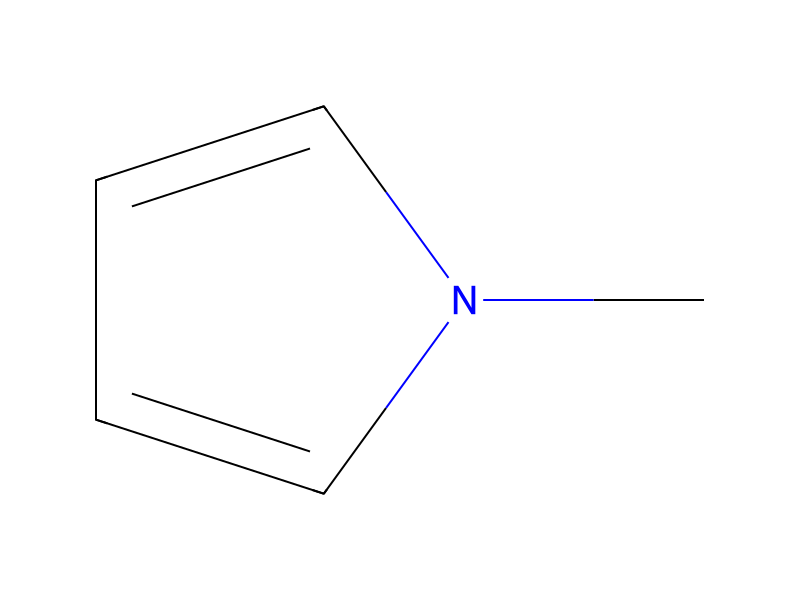
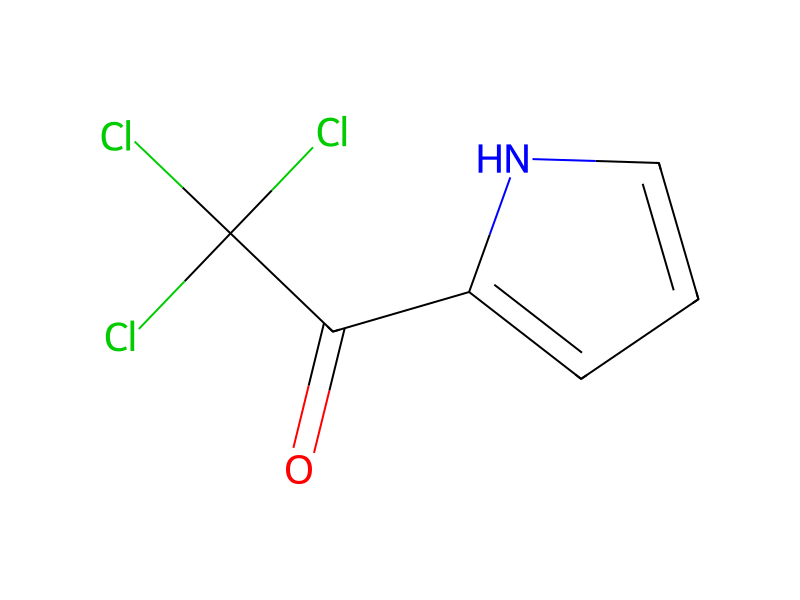
[Cl:1][C:2]([Cl:7])([Cl:6])[C:3](Cl)=[O:4].C[N:9]1[CH:13]=[CH:12][CH:11]=[CH:10]1>C(OCC)C>[Cl:1][C:2]([Cl:7])([Cl:6])[C:3]([C:10]1[NH:9][CH:13]=[CH:12][CH:11]=1)=[O:4]Participants
Reactant 2

Product 1
Reagents, catalysts & solvents 1

Procedure
To a well stirred solution of trichloroacetylchloride (1 kg, 5.5 mole) in 1.5 liters of ethyl ether was added dropwise over a period of 3 hours a solution of N-methylpyrrole (14) (0.45 kg, 5.5 mole) in 1.5 liters of anhydrous ethyl ether. The reaction was allowed to stir for an additional 3 hours and quenched by the dropwise addition of a solution of 400 g of potassium carbonate in 1.5 liters of water. The layers were separated and the ether layer was concentrated in vacuo to provide 2-trichloroacetyl pyrrole (1.2 kg, 5.1 mole) as a yellow crystalline solid, which can be purified by recrystallization from benzene, but is sufficiently pure to be used without further purification. To a cooled (-40° C.) solution of 2-trichloroacetyl pyrrole (1.2 kg, 5.1 mole) in acetic anhydride (6 liters) flask equipped with a mechanical stirrer was added 440 ml of fuming nitric acid over a period of 1 hour while maintaining a temperature of -40° C. The reaction was carefully allowed to warm to room temperature and stirred an additional 4 hours after which the mixture was cooled to -30° C. and isopropyl alcohol (6 liters) was added. The solution was stirred at -20° C. for 30 minutes during which time a white precipitate formed. The solution was allowed to stand for 15 minutes and the resulting precipitate collected by vacuum filtration to provide (15) (0.8 kg, 54% yield). TLC (7:2 benzene/ethyl acetate) Rf 0.7; 1H NMR (DMSO-d6) δ 8.55 (d, 1 H, J=1.7 Hz), 7.77 (d, 1 H, J=1.7 Hz), 3.98 (s, 3 H); 13C NMR (DMSO-d6) δ 173.3, 134.7, 133.2, 121.1, 116.9, 95.0, 51.5; IR (KBr) 1694, 1516, 1423, 1314, 1183, 1113, 998, 750; FABMS m/e 269.936 (M+H 269.937 calc. for C7H5N2O3Cl3).
Workup
- customquenched by the dropwise addition of a solution of 400 g of potassium carbonate in 1.5 liters of water
- customThe layers were separated
- concentrationthe ether layer was concentrated in vacuo
Sources & evidence
- ORD record
- ord-1859ac0f567046d7a6b4ff5b75ee77d5
- Source dataset
- uspto-grants-2000_07
- Patent number
- US06090947
Reaction notes
Loading…