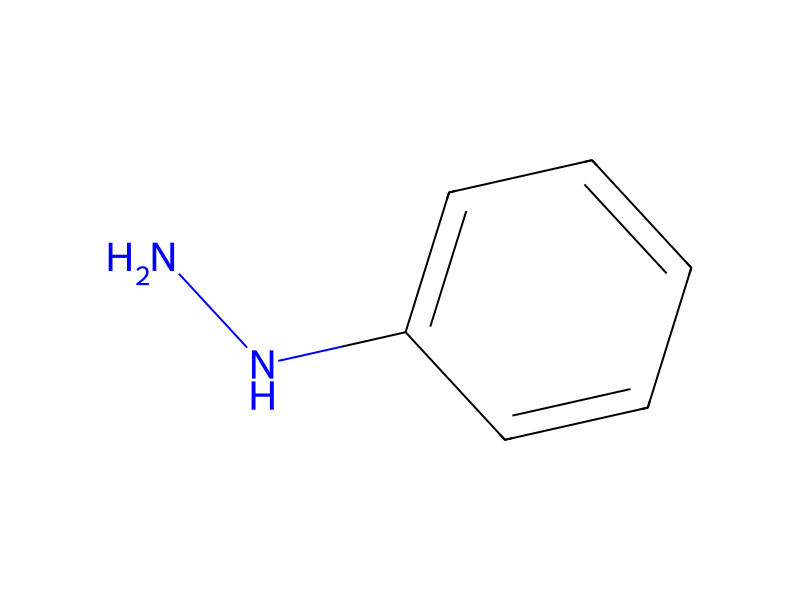
Phenylhydrazine → N,N',2-Triphenylhydrazine-1-carboximidamide
Reaction equation

[C:1]1([NH:7][NH2:8])[CH:6]=[CH:5][CH:4]=[CH:3][CH:2]=1.[C:9]1([N:15]=[C:16]=[N:17][C:18]2[CH:23]=[CH:22][CH:21]=[CH:20][CH:19]=2)[CH:14]=[CH:13][CH:12]=[CH:11][CH:10]=1>C1C=CC=CC=1>[C:18]1([NH:17][C:16]([NH:8][NH:7][C:1]2[CH:6]=[CH:5][CH:4]=[CH:3][CH:2]=2)=[N:15][C:9]2[CH:14]=[CH:13][CH:12]=[CH:11][CH:10]=2)[CH:19]=[CH:20][CH:21]=[CH:22][CH:23]=1Participants
Reactant 2

Product 1

Reagents, catalysts & solvents 1

Procedure
To 300 ml of benzene was added 10 g of phenylhydrazine and the mixture was stirred under ice-cooling. To the solution thus formed was added dropwise 17 g of diphenylcarbodiimide and the mixture was stirred for 5 hours as it was to precipitate crystals, which were recovered by suction filtration to provide 16 g of 1,2-diphenyl-3-anilinoguanidine. Then, 5.8 g of the compound thus obtained and 3.4 g of benzoyl chloride were heat refluxed in 100 ml of toluene for 6 hours; after the reaction was over, toluene was distilled off under reduced pressure, and the oily material thus obtained was dissolved in 80 ml of ethanol. After adding 10 ml of aqueous ammonia to the solution, water was gradually added to the mixture, whereby Compound (1) was obtained as light yellow crystals. The yield for the product was 62.1% and the melting point was 226° to 227.5° C.
Workup
- temperaturecooling
- customTo the solution thus formed
- stirringthe mixture was stirred for 5 hours as it
- customto precipitate crystals, which
- filtrationwere recovered by suction filtration
Sources & evidence
- ORD record
- ord-22767430708b46039367f0386fb702a4
- Source dataset
- uspto-grants-1986_10
- Patent number
- US04615970
Reaction notes
Loading…