Tetrahydrofuran → N-[(1-Ethyl-2-pyrrolidinyl)methyl]-2-methyl-1H-indole-3-carboxamide
Reaction equation

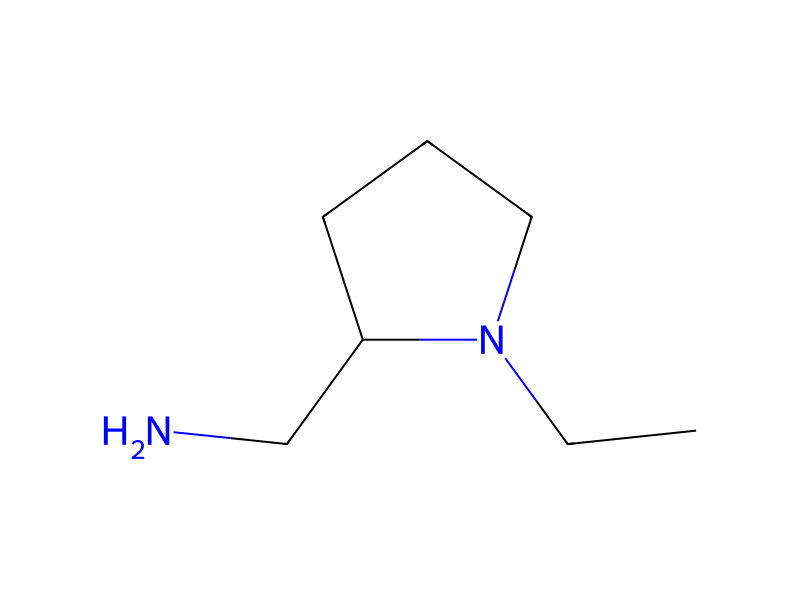
C[C:2]1([C:11](O)=O)[CH:10]=[C:9]2[C:4]([CH:5]=[CH:6][CH:7]=[CH:8]2)=[N:3]1.[CH2:14]([N:16]1[CH2:20][CH2:19][CH2:18][CH:17]1[CH2:21][NH2:22])[CH3:15].C1(N=C=NC2CCCCC2)CCCCC1.[O:38]1CCC[CH2:39]1>>[CH2:14]([N:16]1[CH2:20][CH2:19][CH2:18][CH:17]1[CH2:21][NH:22][C:39]([C:10]1[C:9]2[C:4](=[CH:5][CH:6]=[CH:7][CH:8]=2)[NH:3][C:2]=1[CH3:11])=[O:38])[CH3:15]Participants
5




Procedure
To a solution of 8 g of 2-methylindolecarboxylic acid and 6 g of 1-ethyl-2-pyrrolidinylmethylamine in 140 ml of tetrahydrofuran was added 9.5 g of dicyclohexylcarbodiimide, and the whole mixture was refluxed under heating for 1.5 hours. After cooling, the precipitated dicyclohexylurea was filtered off and the filtrate was concentrated. The resulting residue was crystallized with 20 ml of ethyl acetate and the crystals were filtered with suction and then recrystallized from ethyl acetate to give 10 g of N-(1-ethyl-2-pyrrolidinylmethyl)-2-methylindole-3-carboxamide as white crystals, melting at 132°-135° C.
Workup
- temperaturethe whole mixture was refluxed
- temperatureunder heating for 1.5 hours
- temperatureAfter cooling
- filtrationthe precipitated dicyclohexylurea was filtered off
- concentrationthe filtrate was concentrated
- customThe resulting residue was crystallized with 20 ml of ethyl acetate
- filtrationthe crystals were filtered with suction
- customrecrystallized from ethyl acetate
Sources & evidence
- ORD record
- ord-53e8299959524619aeb59631815adc24
- Source dataset
- uspto-grants-1986_10
- Patent number
- US04616009
Reaction notes
Loading…