N-Methylhomoveratrylamine → HCID 21279707, compound
Reaction equation

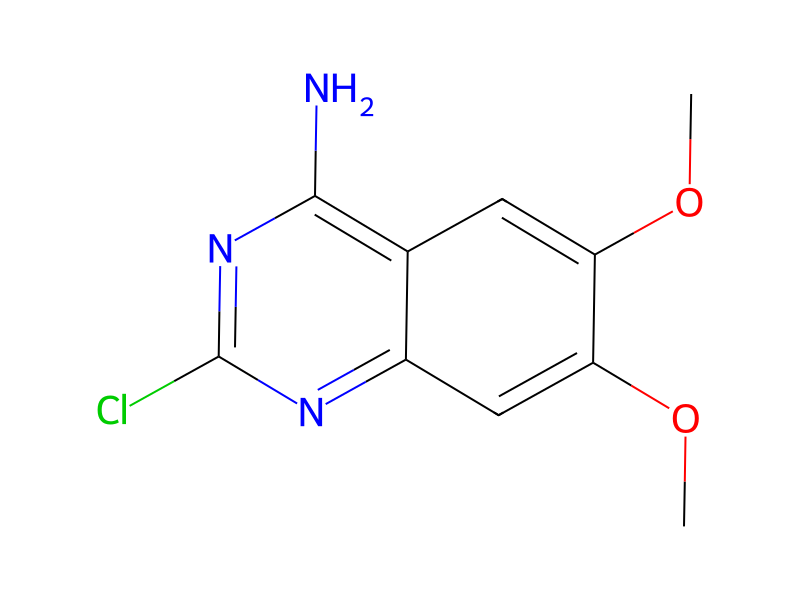
[Cl:1][C:2]1[N:11]=[C:10]([NH2:12])[C:9]2[C:4](=[CH:5][C:6]([O:15][CH3:16])=[C:7]([O:13][CH3:14])[CH:8]=2)[N:3]=1.[CH3:17][NH:18][CH2:19][CH2:20][C:21]1[CH:30]=[CH:29][C:26]([O:27][CH3:28])=[C:23]([O:24][CH3:25])[CH:22]=1>[Cl-].C([N+](CC)(CC)CC1C=CC=CC=1)C>[ClH:1].[CH3:17][N:18]([CH2:19][CH2:20][C:21]1[CH:30]=[CH:29][C:26]([O:27][CH3:28])=[C:23]([O:24][CH3:25])[CH:22]=1)[C:2]1[N:11]=[C:10]([NH2:12])[C:9]2[C:4](=[CH:5][C:6]([O:15][CH3:16])=[C:7]([O:13][CH3:14])[CH:8]=2)[N:3]=1Participants
4
Reactant 2

Product 1

Reagents, catalysts & solvents 1

Conditions
- Temperature
- 110 °C
Procedure
A mixture of 5 g of 2-chloro-4-amino-6,7-dimethoxy quinazoline, 30 g of N-methyl-homoveratryl amine (Lloydia 33, 15-18) and 1 g of triethylbenzyl ammonium chloride was heated with stirring to 110° C. over a 3 hour period. Then the excess of N-methyl-homoveratryl amine was distilled off in vacuo. On standing in the cold, a precipitate was formed from the solution of the evaporation residue in acetone. After filtration with activated charcoal, the precipitate was recrystallized from methanol. The N-methyl-N-(4-amino-6,7-dimethoxy-quinazolin-2-yl)-homoveratryl amine hydrochloride obtained melted at 265°-270° C. with decomposition.
Workup
- temperaturewas heated
- distillationThen the excess of N-methyl-homoveratryl amine was distilled off in vacuo
- customa precipitate was formed from the solution of the evaporation residue in acetone
- filtrationAfter filtration with activated charcoal
- customthe precipitate was recrystallized from methanol
Sources & evidence
- ORD record
- ord-2d31fe75442d45cf8affd6b7693aabe7
- Source dataset
- uspto-grants-1989_01
- Patent number
- US04795750
Reaction notes
Loading…