Ethyl vinyl ether → 1-(6-Ethoxy-5,6-dihydro-4H-1,2-oxazin-3-yl)ethan-1-one
Reaction equation

C(=O)([O-])[O-].[Na+].[Na+].[CH:7]([O:9][CH2:10][CH3:11])=[CH2:8].Cl[CH2:13][C:14](=[N:18][OH:19])[C:15](=[O:17])[CH3:16]>>[CH2:7]([O:9][CH:10]1[O:19][N:18]=[C:14]([C:15](=[O:17])[CH3:16])[CH2:13][CH2:11]1)[CH3:8]Participants
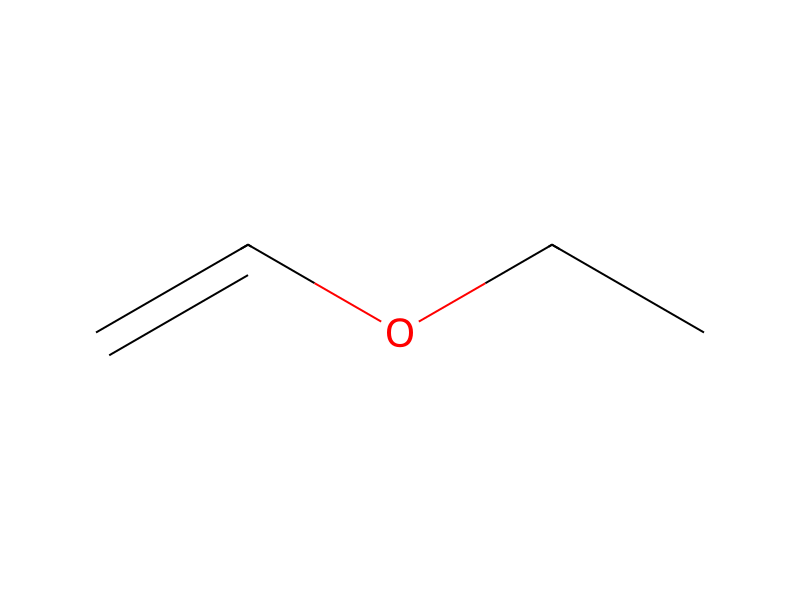



Procedure
A 1000 ml three-neck flask equipped with a mechanical stirrer, a reflux condenser, and a nitrogen inlet adapter was heat dried and charged with nitrogen. When the flask was at room temperature, it was loaded in order: 39.5 g (0.37 mole) of anhydrous sodium carbonate; (with stirring) 132 g (1.83 mole) of ethyl vinyl ether; and (portionwise over a period of 7 minutes) 10.0 g (0.074 mole) of 1-chlorobutan-2,3-dione-2-oxime [Oglobin et al., J. Gen. Chem. U.S.S.R. 34, 2710 (1964)]. Stirring was continued for 21 hours. The reaction mixture was filtered, the solid cake rinsed with diethyl ether, and the combined filtrate and rinses were evaporated under reduced pressure (bath temperature maintained at <40° C.). There was obtained 12.4 g (98%) of the title compound as an oil; nmr spectroscopy indicated it to be essentially 100% pure. This procedure is essentially that described by T. L. Gilchrist, G. M. Iskander and A. K. Yagoub (J. Chem. Soc., Chem. Commun. 1981, 696-698).
Workup
- customA 1000 ml three-neck flask equipped with a mechanical stirrer, a reflux condenser, and a nitrogen inlet adapter
- temperaturewas heat
- customdried
- additioncharged with nitrogen
- customwas at room temperature
- filtrationThe reaction mixture was filtered
- washthe solid cake rinsed with diethyl ether
- customthe combined filtrate and rinses were evaporated under reduced pressure (bath temperature maintained at <40° C.)
Sources & evidence
- ORD record
- ord-5279437c59f1433c84e7c7362629d8db
- Source dataset
- uspto-grants-1989_01
- Patent number
- US04797486
Reaction notes
Loading…