Triethylamine → Diethyl Sulfate
Reaction equation

[O-:1][S:2](C(F)(F)F)(=[O:4])=[O:3].[CH2:9]([O:16]C(=O)C(C)O)[C:10]1C=CC=CC=1.[CH2:22](N(CC)CC)[CH3:23]>ClCCl>[S:2]([O:1][CH2:22][CH3:23])([O:16][CH2:9][CH3:10])(=[O:4])=[O:3]Participants
Reactant 3



Product 1
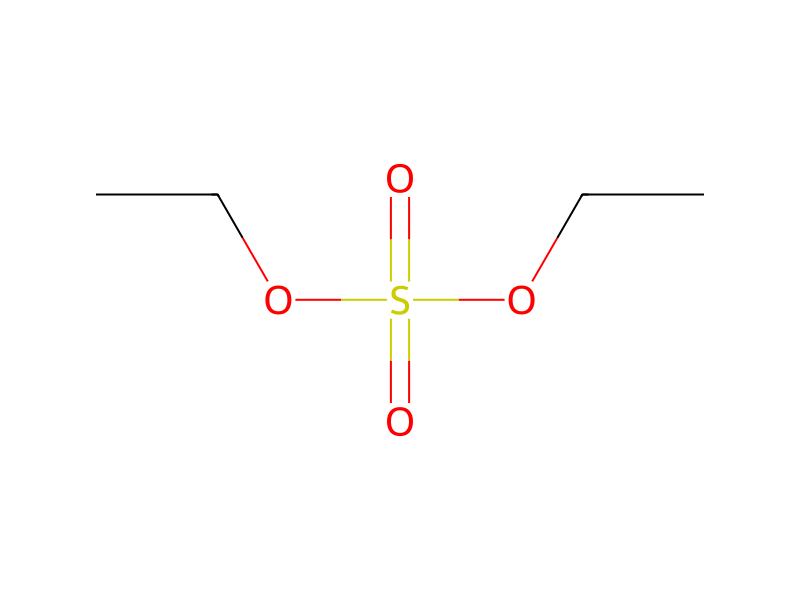
Reagents, catalysts & solvents 1

Procedure
Reaction Scheme A above begins with the triflate of a carboxyl-protected D-αhydroxycarboxylic acid derivative, e.g., lactic acid benzyl ester. By reacting this triflate with α-ethyl-γ-anilido-L-glutamate (prepared, for example, by reacting an amino-protected L-glutamic acid, such as Nα -Cbo-L-glutamic acid, with diethyl sulfate in triethylamine and dichloromethane at room temperature for about three days to give Nα -Cbo-α-ethyl-L-glutamate, forming the dicyclohexylamine salt of the thus-obtained glutamate by reaction with dicyclohexylamine in ethyl acetate at room temperature overnight, acidifying a suspension of the dicyclohexylamine salt and then reacting the isolated free acid with dicyclohexylcarbodiimide and aniline in dichloromethane, first in a dry ice/ice/acetone bath for one hour, and then at room temperature overnight), Nα -[1(L)-carbethoxy-3-carboxanilidopropyl]-L alanine benzyl ester is obtained.
Workup
- customReaction Scheme A
Sources & evidence
- ORD record
- ord-e9b05a6d4a554cc5bf3c38bb7c250d78
- Source dataset
- uspto-grants-1989_01
- Patent number
- US04801721
Reaction notes
Loading…