Phosphorus pentachloride → Benzene, 2-chloro-1-fluoro-4-(trifluoromethyl)-
Reaction equation

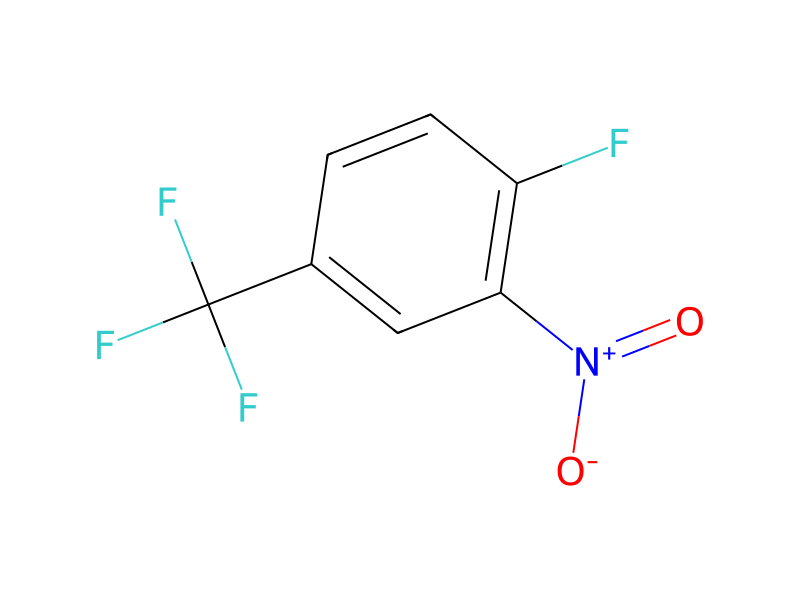
[F:1][C:2]1[CH:7]=[CH:6][C:5]([C:8]([F:11])([F:10])[F:9])=[CH:4][C:3]=1[N+]([O-])=O.P(Cl)(Cl)(Cl)(Cl)[Cl:16]>O>[Cl:16][C:3]1[CH:4]=[C:5]([C:8]([F:11])([F:10])[F:9])[CH:6]=[CH:7][C:2]=1[F:1]Participants
4
Reactant 2

Product 1

Reagents, catalysts & solvents 1

Procedure
Nine parts of the 4-fluoro-3-nitrobenzotrifluoride of Example I, and six parts of phosphorous pentachloride were sealed tightly under a nitrogen atmosphere in a tubular reactor. The sealed reactor was heated in an oil bath for about two hours at 170°-180° C. The reaction mixture was poured into water and extracted with diethyl ether. The organic layer was dried and distilled at atmospheric pressure to yield 13.6 parts of 3-chloro-4-fluorobenzotrifluoride. The structure was confirmed by gas chromatography--mass spectrum, and by F19 and C13NMR analyses.
Workup
- temperatureThe sealed reactor was heated in an oil bath for about two hours at 170°-180° C
- extractionextracted with diethyl ether
- customThe organic layer was dried
- distillationdistilled at atmospheric pressure
Sources & evidence
- ORD record
- ord-570dfa12d4314503859b18c47c0adde6
- Source dataset
- uspto-grants-1984_01
- Patent number
- US04424396
Reaction notes
Loading…