2-Chloro-6,7-dimethoxy-4-quinazolinamine → HCID 20473803, compound
Reaction equation

[NH2:1][C:2]1[C:11]2[C:6](=[CH:7][C:8]([O:14][CH3:15])=[C:9]([O:12][CH3:13])[CH:10]=2)[N:5]=[C:4]([Cl:16])[N:3]=1.[C:17]1([C:23]2([C:28]([N:30]3[CH2:35][CH2:34][NH:33][CH2:32][CH2:31]3)=[O:29])[CH2:27][CH2:26][CH2:25][CH2:24]2)[CH:22]=[CH:21][CH:20]=[CH:19][CH:18]=1>C(O)CC(C)C>[OH2:12].[ClH:16].[NH2:1][C:2]1[C:11]2[C:6](=[CH:7][C:8]([O:14][CH3:15])=[C:9]([O:12][CH3:13])[CH:10]=2)[N:5]=[C:4]([N:33]2[CH2:34][CH2:35][N:30]([C:28]([C:23]3([C:17]4[CH:18]=[CH:19][CH:20]=[CH:21][CH:22]=4)[CH2:24][CH2:25][CH2:26][CH2:27]3)=[O:29])[CH2:31][CH2:32]2)[N:3]=1Participants
4
Reactant 2
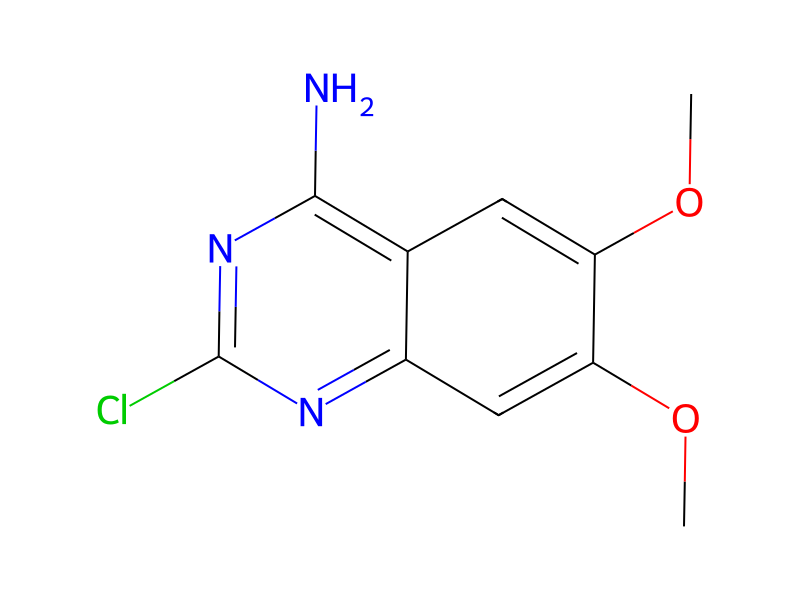

Product 1

Reagents, catalysts & solvents 1

Procedure
To 25 ml of isopentanol were added 1.2 g of 4-amino-2-chloro-6,7-dimethoxyquinazoline and 1.55 g of 1-(1-phenylcyclopentylcarbonyl)piperazine, and the resulting mixture was heated under reflux for 4 hours. The crystals thus produced were collected by filtration and recrystallized from 50% v/v aqueous ethanol, to give 1.90 g of the desired compound No. 60 hydrochloride hydrate in the form of colourless powdery crystals melting at 277°-278° C. (with decomposition).
Workup
- temperaturethe resulting mixture was heated
- temperatureunder reflux for 4 hours
- customThe crystals thus produced
- filtrationwere collected by filtration
- customrecrystallized from 50% v/v aqueous ethanol
Sources & evidence
- ORD record
- ord-6d1d84ccbdc14846990e3a4914c08b1d
- Source dataset
- uspto-grants-1984_01
- Patent number
- US04426382
Reaction notes
Loading…