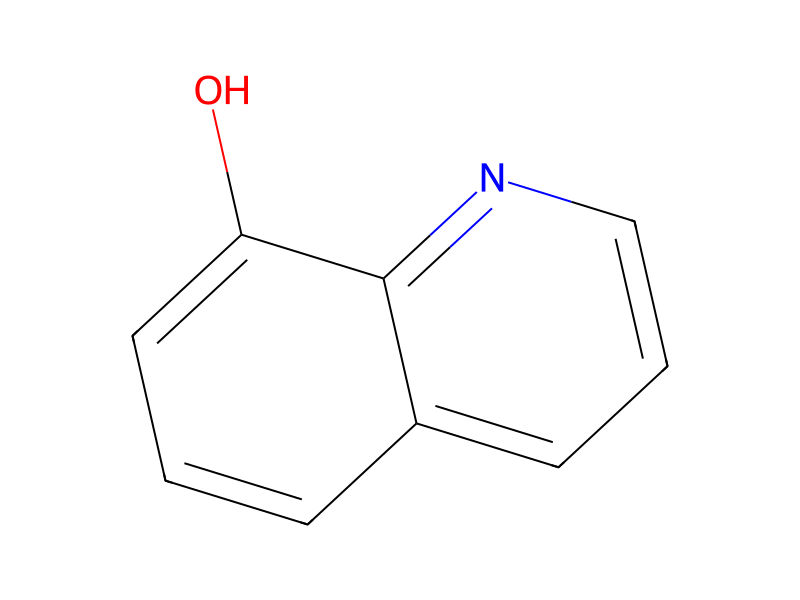
8-Hydroxyquinoline → 8-Quinolyl acrylate
Reaction equation

[OH:1][C:2]1[CH:3]=[CH:4][CH:5]=[C:6]2[C:11]=1[N:10]=[CH:9][CH:8]=[CH:7]2.C(N(CC)CC)C.[C:19](Cl)(=[O:22])[CH:20]=[CH2:21]>C1(C)C=CC=CC=1>[C:19]([O:1][C:2]1[CH:3]=[CH:4][CH:5]=[C:6]2[C:11]=1[N:10]=[CH:9][CH:8]=[CH:7]2)(=[O:22])[CH:20]=[CH2:21]Participants
Reactant 3


Product 1

Reagents, catalysts & solvents 1

Procedure
8-Hydroxyquinoline (58.0 g: 0.40 mole) was dissolved in a mixture of toluene (500 ml) and triethylamine (41.4 g; 0.41 mole). Acrylyl chloride (38.0 g; 0.42 mole) was added slowly, while stirring, the reaction temperature beting kept under 30° C. When the addition was complete the mixture was stirred for another 1 hour. The solution was then filtered and washed with a solution of sodium hydrogen carbonate in water followed by water only, and finally the toluene layer was dried with anhydrous sodium sulphate. Some toluene was evaporated off using a rotary evaporator under low pressure. The solution was left in a refrigerator overnight and the solid formed was filtered off. This was identified by infra-red and N.M.R. spectroscopy and microanalysis to be 8-quinolinyl acrylate. Yield 48.6 g (61 percent of the theoretical yield).
Workup
- custombeting kept under 30° C
- additionWhen the addition
- stirringwas stirred for another 1 hour
- filtrationThe solution was then filtered
- washwashed with a solution of sodium hydrogen carbonate in water
- dry with materialfinally the toluene layer was dried with anhydrous sodium sulphate
- customSome toluene was evaporated off
- customa rotary evaporator under low pressure
- customthe solid formed
- filtrationwas filtered off
- customYield 48.6 g (61 percent of the theoretical yield)
Sources & evidence
- ORD record
- ord-8dd3bdb446d74bf18c2ee8f8ed872ba7
- Source dataset
- uspto-grants-1984_01
- Patent number
- US04426464
Reaction notes
Loading…