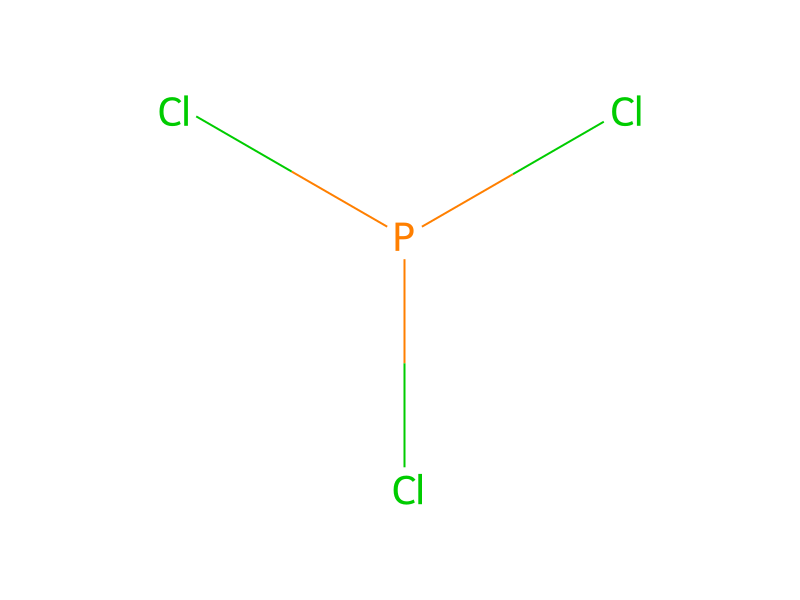
Phosphorus trichloride → 4-Chloro-2,8-bis(trifluoromethyl)quinoline
Reaction equation

P(Cl)(Cl)[Cl:2].[F:5][C:6]([F:23])([F:22])[C:7]1[CH:16]=[C:15](O)[C:14]2[C:9](=[C:10]([C:18]([F:21])([F:20])[F:19])[CH:11]=[CH:12][CH:13]=2)[N:8]=1>>[F:5][C:6]([F:23])([F:22])[C:7]1[CH:16]=[C:15]([Cl:2])[C:14]2[C:9](=[C:10]([C:18]([F:21])([F:20])[F:19])[CH:11]=[CH:12][CH:13]=2)[N:8]=1Participants
3


Procedure
A mixture of 100 parts by volume of phosphorus trichloride and 40 parts of 2,8-bis-(trifluoromethyl)-4-hydroxyquinoline is refluxed for 8 hours. Most of the excess phosphorus trichloride is then distilled off, the residue is poured onto 200 parts of ice-water and the pH is brought to 12-13 with 12 N sodium hydroxide solution. The mixture is then extracted with methylene chloride, the extract is dried over sodium sulfate and the solvent is stripped off under reduced pressure. 40.2 parts=94% of theory of 2,8-bis-(trifluoromethyl)-4-chloroquinoline of melting point 40°-42° C. are obtained.
Workup
- temperatureis refluxed for 8 hours
- distillationMost of the excess phosphorus trichloride is then distilled off
- additionthe residue is poured onto 200 parts of ice-water
- extractionThe mixture is then extracted with methylene chloride
- dry with materialthe extract is dried over sodium sulfate
Sources & evidence
- ORD record
- ord-d2947c8d0014420c8d17564144afd104
- Source dataset
- uspto-grants-1984_01
- Patent number
- US04429130
Reaction notes
Loading…