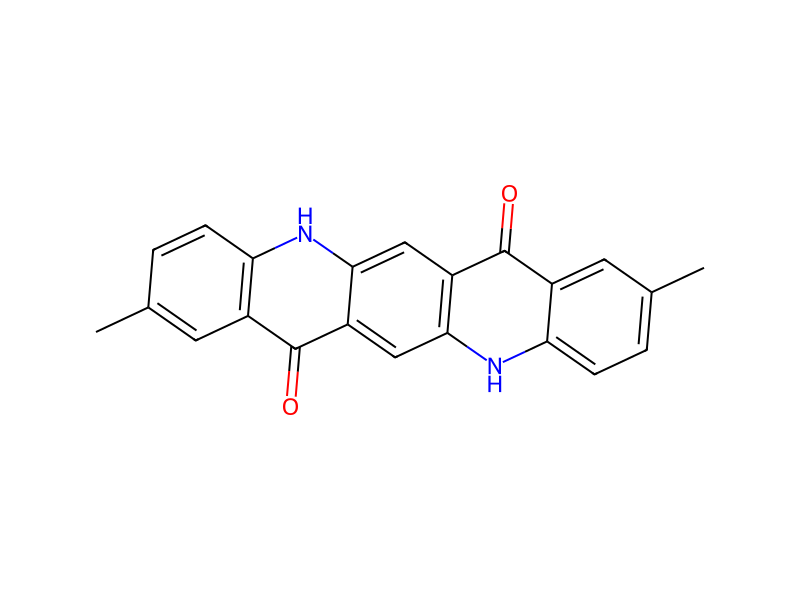
Methanol → 5,12-Dihydro-2,9-dimethylquino(2,3-b)acridine-7,14-dione
Reaction equation

[CH3:1][C:2]1[CH:28]=[CH:27][C:5]([NH:6][C:7]2[CH:15]=[C:14]([C:16]([OH:18])=O)[C:13]([NH:19][C:20]3[CH:25]=[CH:24][C:23]([CH3:26])=[CH:22][CH:21]=3)=[CH:12][C:8]=2[C:9](O)=[O:10])=[CH:4][CH:3]=1.P(=O)(O)(O)O.CO>O.S(N(C1C=C(C(O)=O)C(N(S(=O)(=O)N)C2C=CC=CC=2)=CC=1C(O)=O)C1C=CC=CC=1)(=O)(=O)N.C(N(CC)S(C1C=CC(NC2C=C(C(O)=O)C(NC3C=CC(S(=O)(=O)N(CC)CC)=CC=3)=CC=2C(O)=O)=CC=1)(=O)=O)C>[CH3:1][C:2]1[CH:28]=[CH:27][C:5]2[NH:6][C:7]3[C:8]([C:9](=[O:10])[C:4]=2[CH:3]=1)=[CH:12][C:13]1[NH:19][C:20]2[CH:25]=[CH:24][C:23]([CH3:26])=[CH:22][C:21]=2[C:16](=[O:18])[C:14]=1[CH:15]=3Participants
Reactant 3



Product 1
Reagents, catalysts & solvents 3



Conditions
- Temperature
- 94 °C
Procedure
To 720 g of polyphosphoric acid (117%) heated at 90° C. were added 3.2 g of 2,5-di(sulfamoylanilino)terephthalic acid followed by 8 g of 2,5-di[4-(N,N-diethylsulfamoyl)anilino]terephthalic acid. The mixture was stirred for five minutes, after which 160 g of 2,5-di(4-methylanilino)terephthalic acid were added over a period of approximately 75 minutes, the temperature being maintained below 105° C. by adjustment of the addition rate. The reaction mixture was held at 105° C. for five hours and then cooled to 94° C. To this mixture was added 105.8 g of phosphoric acid (75%) dropwise over a period of approximately 30 minutes. The resultant melt was allowed to stir for 15 minutes at 90° C. and then poured slowly into 1120 g of methanol, the temperature being maintained below reflux using a water bath. The slurry was allowed to cool to room temperature and stand for 16 hours. The pigment slurry was heated at reflux for one hour, cooled below 65° C., diluted with water, collected by filtration, and washed with water until free of acid. The resultant presscake was reslurried in water and heated to 45° C. After the slurry was acidified to pH 2.3, an emulsion of 4.7 g of an anionic surfactant, 69.7 g of a petroleum distillate, and 160 g of water was added, and the slurry was stirred for three hours. The resultant slurry was collected by filtration and washed with water. The wet cake can be dried or used as is for specific applications. Here, the wet cake was dried in an oven at 60° C. to give approximately 152 g of 2,9-dimethylquinacridone as a magenta pigment.
Workup
- temperaturethe temperature being maintained below 105° C. by adjustment of the addition rate
- waitThe reaction mixture was held at 105° C. for five hours
- stirringto stir for 15 minutes at 90° C.
- temperaturethe temperature being maintained
- temperaturebelow reflux
- temperatureto cool to room temperature
- waitstand for 16 hours
- temperatureThe pigment slurry was heated
- temperatureat reflux for one hour
- temperaturecooled below 65° C.
- filtrationcollected by filtration
- washwashed with water until free of acid
- temperatureheated to 45° C
- additionan emulsion of 4.7 g of an anionic surfactant, 69.7 g of a petroleum distillate, and 160 g of water was added
- stirringthe slurry was stirred for three hours
- filtrationThe resultant slurry was collected by filtration
- washwashed with water
- customThe wet cake can be dried
- customHere, the wet cake was dried in an oven at 60° C.
Sources & evidence
- ORD record
- ord-6f0ee0edb2d7498cba9deea3de8a7299
- Source dataset
- uspto-grants-2002_12
- Patent number
- US06494948B2
Reaction notes
Loading…