Hydrochloric Acid → HCID 21958048, compound
Reaction equation
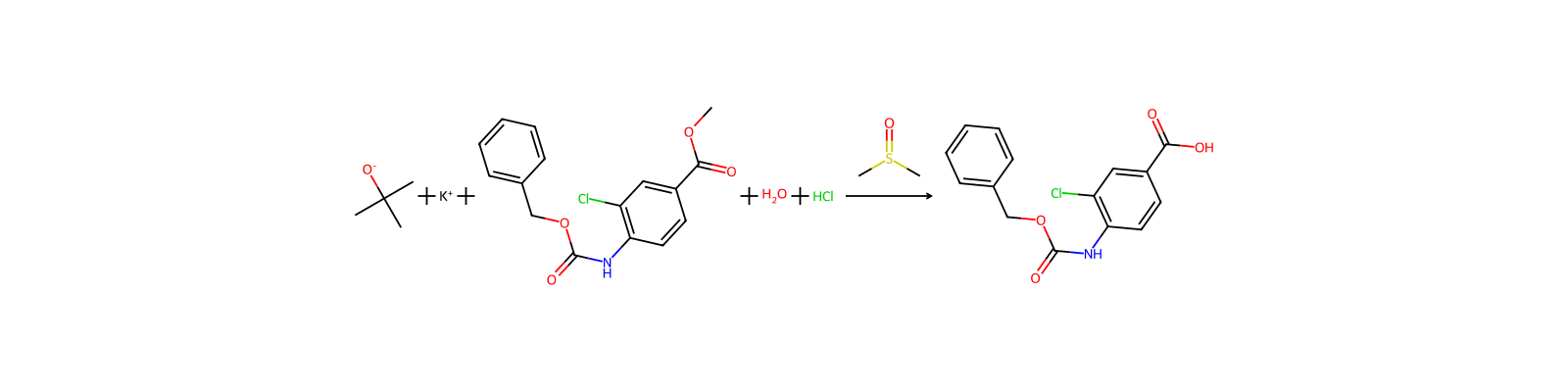
CC(C)([O-])C.[K+].[CH2:7]([O:14][C:15]([NH:17][C:18]1[CH:27]=[CH:26][C:21]([C:22]([O:24]C)=[O:23])=[CH:20][C:19]=1[Cl:28])=[O:16])[C:8]1[CH:13]=[CH:12][CH:11]=[CH:10][CH:9]=1.O.Cl>CS(C)=O>[CH2:7]([O:14][C:15]([NH:17][C:18]1[CH:27]=[CH:26][C:21]([C:22]([OH:24])=[O:23])=[CH:20][C:19]=1[Cl:28])=[O:16])[C:8]1[CH:13]=[CH:12][CH:11]=[CH:10][CH:9]=1Participants
Reactant 4




Product 1

Reagents, catalysts & solvents 1

Procedure
Potassium t-butoxide (24.7 g) was dissolved in dimethylsulfoxide (221 ml) and admixed with methyl 4-benzyloxycarbonylamino-3-chlorobenzoate (4.52 g) and the mixture was stirred at room temperature for 25 minutes. The reaction mixture was poured into water (200 ml), which was then acidified with 1N hydrochloric acid (225 ml) and then extracted with ethyl acetate. The ethyl acetate layer was washed successively with water and saturated brine, and dried over magnesium sulfate. The solvent was distilled off under reduced pressure, and the residue was purified by column chromatography on silica gel (ethyl acetate/hexane=2:5). A desired fraction was concentrated under reduced pressure to obtain 4-benzyloxycarbonylamino-3-chlorobenzoic acid (2.47 g) as a white powder.
Workup
- extractionextracted with ethyl acetate
- washThe ethyl acetate layer was washed successively with water and saturated brine
- dry with materialdried over magnesium sulfate
- distillationThe solvent was distilled off under reduced pressure
- customthe residue was purified by column chromatography on silica gel (ethyl acetate/hexane=2:5)
- concentrationA desired fraction was concentrated under reduced pressure
Sources & evidence
- ORD record
- ord-4694f3c9470744059232718b8b1edbaf
- Source dataset
- uspto-grants-2002_12
- Patent number
- US06495604B1
Reaction notes
Loading…