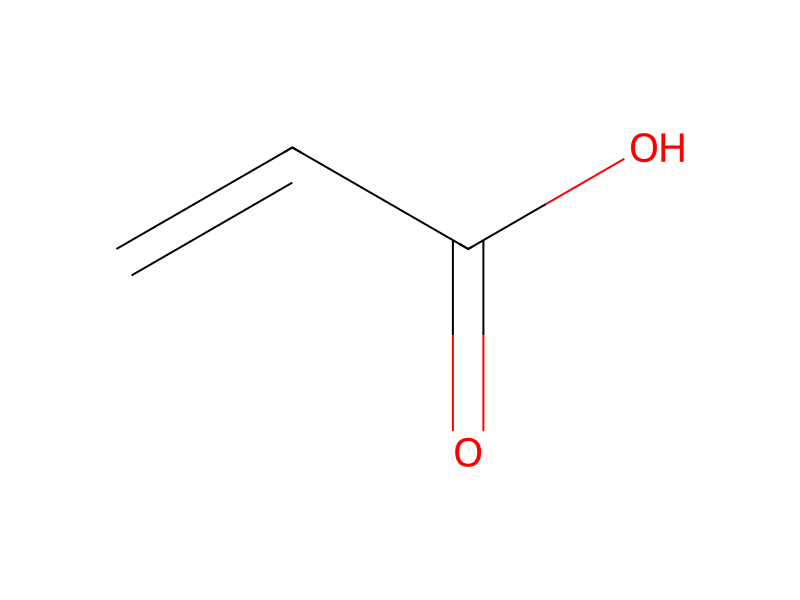
Acrylic Acid → HCID 12040557, compound
Reaction equation

[C:1]([Si:5]([CH:10]([CH3:12])[CH3:11])([CH:7]([CH3:9])[CH3:8])Cl)([CH3:4])([CH3:3])[CH3:2].C(C1C=C(C)C=C(C(C)(C)C)C=1O)(C)(C)C.C(N(CC)CC)C.[C:36]([OH:40])(=[O:39])[CH:37]=[CH2:38]>C1(C)C=CC=CC=1>[C:36]([O:40][Si:5]([C:1]([CH3:4])([CH3:3])[CH3:2])([CH:10]([CH3:12])[CH3:11])[CH:7]([CH3:9])[CH3:8])(=[O:39])[CH:37]=[CH2:38]Participants
Reactant 4



Product 1

Reagents, catalysts & solvents 1

Conditions
- Temperature
- 80 °C
Procedure
A flask equipped with a stirrer, reflux condenser, dropping funnel and thermometer was charged with 41.4 g (0.20 mol) of tert-butyldiisopropylchlorosilane, 60 ml of By toluene, and 0.06 g of 2,6-di-tert-butyl-4-methylphenol. At room temperature, 22.3 g (0.22 mol) of triethylamine was added dropwise over one hour. At the end of dropwise addition, the flask was heated at 80° C. After the internal temperature became constant, 15.9 g (0.22 mol) of acrylic acid was added dropwise over one hour. After the completion of dropwise addition, the reaction solution was stirred for 2 hours at 80° C. The reaction solution was then cooled to room temperature, and the resulting hydrochloric acid salt removed by filtration. The filtrate was distilled, collecting 42.9 g of a fraction having a boiling point of 80-83° C./0.27 kPa.
Workup
- customA flask equipped with a stirrer
- temperaturereflux condenser
- additionAt the end of dropwise addition
- additionAfter the completion of dropwise addition
- temperatureThe reaction solution was then cooled to room temperature
- customthe resulting hydrochloric acid salt removed by filtration
- distillationThe filtrate was distilled
- customcollecting 42.9 g of a fraction
Sources & evidence
- ORD record
- ord-6985941980ec44368610ca3abd356670
- Source dataset
- uspto-grants-2002_12
- Patent number
- US06498264B2
Reaction notes
Loading…